

Verizon and network partner Ericsson completed a pre-standard “6G” field call in the 7 GHz band at a site in California, a test that bolsters the carrier’s push to be at the forefront of still developing 6G standards.
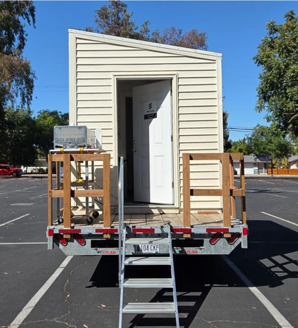
The test used 400-megahertz of spectrum in the 7 GHz band across a single channel that was beamed from base station installed near a commercial Verizon site in Concord, California. The signal was beamed to user equipment housed within a 12-by-8-foot mobile enclosure lined with wall and window materials of various thicknesses and materials to “enable differentiated testing of indoor coverage.”
“This achievement is not only an indoor penetration test: the confirmed field result is an outdoor call, while the broader proof-of-concept examines how 6G performance carries from open air into indoor spaces,” the companies noted of the trial. “Testing characterizes coverage, throughput, latency, stability, and feature behavior under realistic conditions, including line-of-sight and non-line-of-sight paths, foliage, obstacles, and outside-in penetration through different glass and building materials.”
They also reaffirmed that “the milestone is a pre-standard proof-of-concept demonstration and is not a commercial 6G service launch. Verizon and Ericsson will continue analyzing field results and applying the learnings to future 6G research, testing, and deployment planning.”
Verizon’s 6G efforts gain velocity
Verizon CTO Yago Tenorio noted that Ericsson was one of the founding members of the carrier’s 6G Innovation Forum. That group was launched late last year with partners Ericsson, Samsung, Nokia, Meta, and Qualcomm, and tasked itself with the heady goal of establishing “an open, diversified, and resilient 6G ecosystem and develop foundational 6G technologies while ensuring global alignment."
Tenorio at that time explained to SDxCentral in an interview that use cases will drive this 6G development path.
“This time around, we want to design a 6G system with a set of use cases in mind, so that it comes to solve some problems, pressing problems, and enable some things that you cannot do today,” Tenorio said.
The executive pointed to a handful of those challenges, including the growing need for mobile networks to deal with more symmetrical traffic patterns driven by new AI-related applications.
“Every system has been designed with downlink in mind, with radios that could be like nine-to-one or eight-to-two, or downlink dominated everything and uplink was a minority,” Tenorio said, noting current 5G network standards favoring more spectrum assets tied to the downlink channel in support of video streaming services. “Well, that may change. AI may change that.”
Tenorio also noted that 6G networks could be more important for edge-based services that need to support IoT devices with limited form factors.
“We don't know what's the form factor, but what we know for sure is that the form factor is going to be smaller, and smaller means less heat is able to be dissipated, there is less space for hosting a battery,” Tenorio said. “Then the question is, what 6G can really do to relieve the device from those limitations.”


Comments