

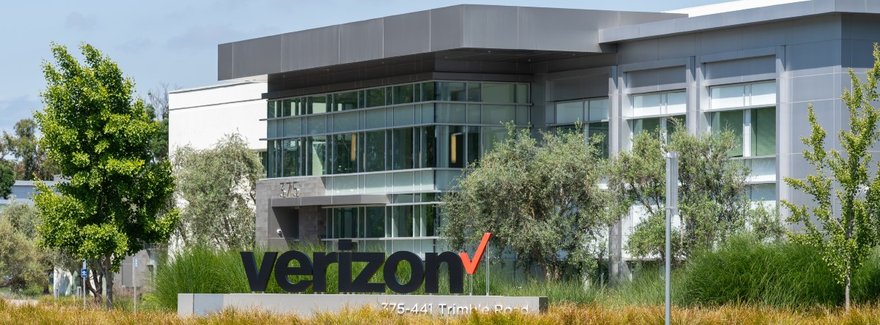

Verizon remains a fulcrum for private network opportunities, an ongoing market enigma hyped with unbound opportunities but weighed down by market realities, and providing a growing challenge for market prognosticators that are having to more finely filter data for their forecast models.
Verizon CEO Hans Vestberg during an investor conference this week again highlighted the carrier’s progress in that space. This includes new network updates that allow Verizon to deploy private 5G networks much quicker than it had been able to in the past.
Vestberg told the audience at this week’s J.P. Morgan Global Technology, Media, and Communications Conference that the carrier’s deployment of a 5G Standalone (SA) core to power between 60 and 70 percent of its 5G network today allows it to support advanced network slicing technologies to power private 5G “way quicker [and] more efficient for our customers. It takes instead of weeks to set up, it will come down to days.”
Verizon had previously touted this network slicing capability in support of its public safety focused Frontline offering.
Vestberg also continued to link that private network opportunity to bolstering the carrier’s edge network agenda, a notion accelerated by growing artificial intelligence (AI) and generative AI (genAI) adoption.
“I think that many, together with me, believes that a lot of the genAI applications that's going to be enterprise driven, they're going to sit at the edge of the network because of transport costs, security, and privacy, many companies, like Verizon, you want to have it [on-premises], whatever you have, you want it [on-premises]. That could be a third party, but still it's going to be our data centers,” Vestberg said of this link and opportunity. “I think this hangs together all the way from private 5G network and edge computing.”
Vestberg has admittedly been willing this opportunity along for some time, noting, “we were very early on mobile edge compute, maybe too early, and I take that responsibility. But I'd rather be too early on something than being too late. Now we're sitting in a really good position on monetizing that investment and our assets we have there.”
While Vestberg is a long-time cheerleader, other operators are also on board the private network hype train.
Callie Field, president of T-Mobile US’ Business Group, noted the carrier’s success in powering a private 5G and network security slice platform for a Disney Studios production. “That was a very cool use case,” Field said during the carrier’s first-quarter earnings call.
Where is the private network space headed?
However, those opportunities remain few and far between, which continues to stump forecasts. A perfect example of the prognostication challenge was a pair of recent reports from Juniper Research and ABI Research, with the former finding opportunities while the latter discovering challenges.
Juniper Research’s latest research is predicting the number of enterprises deploying private networks will surge from around 2,500 this year to more than 7,000 globally by the end of the decade. That growth surge is predicted to be based on the need for “greater data control and security as regulations surrounding data tighten, with enhanced reliability and ultra-low latency enabling real-time threat detection and response.”
Manufacturing is forecast to lead that surge, as has been the case for years, “due to its high level of process automation and well-developed infrastructure,” with other sectors following along more slowly due to “higher costs and underdeveloped infrastructure significantly inhibiting additional revenue streams.”
Juniper did note that operators could see some success with a neutral-host model. This model is centered on a single entity owning the infrastructure and then partnering with other operators to run service over that infrastructure. This is typically used in locations with limited space for redundant equipment.
Vendors are starting to see some progress with this model. Ericsson CFO Lars Sandstrom during that vendor’s latest earnings call did note that its enterprise wireless solution sales increased 19 percent, “with strong growth in private 5G and neutral host solutions.”
Verizon this week did report a deal with the Buffalo Bills to provide and own a neutral-host distributed antenna system (DAS) at the NFL team’s new stadium that is scheduled to open next year. This neutral-host model would allow other operators to supply cellular-based services using the Verizon installed and run infrastructure.
Despite those bright points, ABI Research continues to see more dark space. The firm noted that a recent survey of 458 manufacturing decision-makers in the United States, Germany, and Malaysia found consistent private network adoption in the latter two, but dwindling support in the US where the firm expects private 5G deployments to dip 11 percent this year.
Shadine Taufik, research analyst at ABI Research, pointed to previous research that pinned some of that drop on the current U.S. tariff policy as one of several “destabilizing activities” that could impact private network adoption.
“Interest in private cellular has declined due to budgeting constraints or reprioritization of transformation initiatives, especially amid tariff uncertainties,” Taufik wrote. “Administration changes, geopolitical tensions across key manufacturing hubs in Asia, and prioritization of other, more ROI-centric tech have hindered private cellular growth.”
Taufik added that it’s important private network providers continue to espouse the cost-saving opportunities, “highlighting the medium-term benefits of their products to elicit greater interest amid the instability.”
Comments