


A new report revealed AI is contributing just 2.5% of revenue for telecom operators despite a capex envelope equivalent to nearly 20% of profits.
The findings were revealed in GSMA Intelligence’s third-quarter (Q3) report looking at the state of the AI market in telecom. In its analysis of publicly announced deployments across more than 760 operators worldwide, the telecom body found operators in a balancing act of leveraging AI opportunities while maintaining financial discipline and operational security – topped off with the need for demonstrable commercial returns.
Approximately 66% of tracked telecom AI deployments are now operational, compared with around 60% in the previous quarter. With AI currently contributing around 2.5% of operator revenue, GSMA noted potential space for "significant headroom" in the B2B space, which accounts for around one-quarter of telecom revenue.
GSMA stressed that announcing AI services or increasing deployment numbers doesn’t necessarily translate to incremental revenue or sustainable returns. Its research also showed a return on investment (ROI) was less fundamental to operators when compared to potential productivity and cost gains through AI use.
Operators worldwide recorded an average of 1.6 publicly announced deployments. Worldwide, 66% of tracked initiatives are live, 4% remain in trials, and 30% are classified as commitments. Although live deployments have increased, the tracker showed that the global split between cost-saving and revenue objectives remains broadly unchanged, moving from 61% cost-saving and 39% revenue-focused in Q2 to 62% and 38%, respectively, in Q3.
Globally, customer care was the largest category, representing 43% of tracked AI deployments in Q3 2026, down from 44% in Q2. AI-infused sales and marketing accounted for 27%, while network-related applications remained at 17%.
AI applications seen over the quarter include network automation, AI radio access networks (AI RAN), and infrastructure optimization. GSMA identified AI-enhanced connectivity as the most widely offered revenue-generating AI use case as reported by 75% of operators, followed by GPU-as-a-service (GPUaaS) at 69%, edge and distributed inference at 57%, industry-specific or vertical AI solutions at 54%, and sovereign computing at 37%.
Nvidia and Perplexity: Twin suns of the telecom AI ecosystem
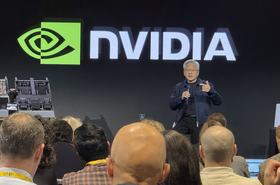
On the supply side, the AI vendor ecosystem is predictably made up of the chip giants, with Nvidia ranked first among publicly announced telecom AI partnerships for both large and smaller operators, and thereby billed by the GSMA as "the sun of the AI ecosystem."
AMD ranked second and Intel third out of the GPU suppliers, with the listings reversed among smaller operators. Perhaps unsurprisingly, Amazon Web Services (AWS) leads the hyperscaler partnership rankings for all sizes of operator, ahead of Microsoft and Google.
AI vendor Perplexity came first among the frontier AI labs being used in telecom, ahead of OpenAI and DeepSeek. GSMA Intelligence put this lead down partly to Perplexity's scope for customization within telecom-specific propositions.
Infrastructure represents approximately 25% of telecom AI spending, encompassing GPUs, data centers, dark fiber, and related physical assets.
GSMA's report also revealed smaller operators spend a greater proportion of their revenue (6.4%) on AI, especially in the Middle East. But as to be expected, bigger operators are scaling AI deployments beyond the pilot phase.
"The priority is to embed AI in network security architecture, with least-privilege access, isolation, monitoring, and human oversight for high-impact actions. The trade-off is real. Deploying too slowly risks missing productivity and revenue opportunities. Deploying too quickly risks compromising trusted infrastructure. Security-by-design should determine where AI can scale and where deployment should pause until controls are proven," GSMA researchers concluded.



Comments