

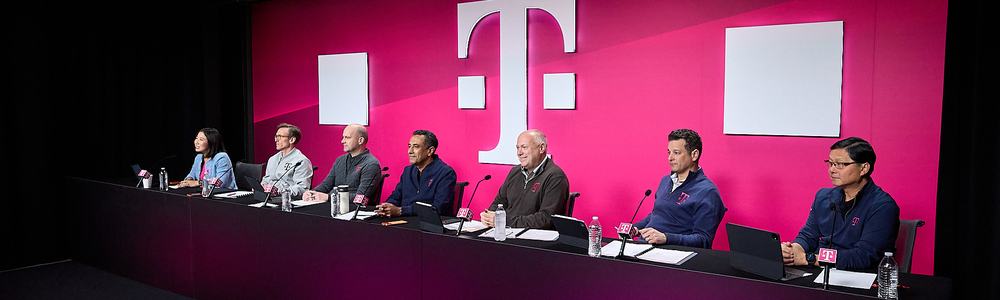
T-Mobile US reported its first-quarter earnings this week, but the main question on most people's lips was whether there's any truth to reports that the carrier could merge with parent company Deutsche Telekom (DT).
The question was put to T-Mobile US CEO Srini Gopalan during the carrier's earnings call this week, to which Gopalan said the telco won't be commenting on such matters.
However, Gopalan did suggest that there has been some thinking behind the scenes around a potential merger.
"As a matter of policy, we do not comment on market rumors or speculation, nor is there anything specific to comment on anyway," Gopalan said. "However, the article has raised a lot of questions inbound on governance. We have looked into the governance, and what I have been told is hypothetically, if someone were to ever consider such a transaction reported in the article, that would specifically require a separate approval process by disinterested shareholders, what many of you refer to as majority of the minority."
DT previously regained its majority stake in T-Mobile US back in 2023. DT has had a stake in T-Mobile US since 2001, with its current stake sitting at 53%.
Bloomberg reported that a potential deal would create a corporate group that controls the operations of DT and T-Mobile US, and would be jointly owned by the two companies’ current investors.
For the quarter itself, T-Mobile US reported revenue of $23.1 billion, which was up 10.6% year-over-year (YoY). The carrier reported that net income decreased 15% YoY to $2.5 billion, though this included the impact of the company's UScellular acquisition last year.
For the quarter, T-Mobile US added 217,000 postpaid net account additions for broadband and mobile services, which was up 5% YoY, while average monthly postpaid service revenue earned per account rose 3.9% to $151.93.
Because of the better-than-expected performance, T-Mobile US raised its forecasts for postpaid account additions to between 950,000 and one million this year, up from a prior range of 900,000 to one million.

The US fiber frenzy
Can M&A help US carriers meet their build-out targets?
Hungry for more fiber
One of T-Mobile US' main headlines this week was once again centered around its fiber ambitions.
The carrier announced on Tuesday that it will invest $2.7 billion as part of two new fiber joint ventures.
This includes a 50/50 joint venture (JV) with Oak Hill Capital to acquire and combine GoNetspeed and Greenlight Networks, and a separate 50/50 JV with Wren House to acquire i3 Broadband.
T-Mobile US aims to reach 12 to 15 million households with fiber by the end of 2030. The carrier notably sealed its acquisition of Lumos last year as part of a JV with EQT Infrastructure, along with its fiber JV acquisition of Metronet a few months later.
By the end of the decade, the carrier expects to hit between three and four million fiber subscribers.
"We are not looking at a master plan on having fiber everywhere. We are looking geographically with each of the partners at where it makes sense to build, where we can create value out of these builds," André Almeida, chief broadband, enterprise, and emerging business officer at T-Mobile US, noted.
Almeida pointed out that the creation of fiber JVs has been successful for T-Mobile US in the recent past, highlighting the carrier's fiber JV acquisitions of Lumos and Metronet.


T-Mobile, Starlink unveil SuperBroadband offering
One of the other big announcements coming out of the carrier this week concerned T-Mobile US' ongoing partnership with SpaceX subsidiary Starlink.
As part of this, T-Mobile US unveiled its SuperBroadband service, which the carrier explains will combine its 5G standalone network with Starlink's broadband "to deliver ultimate redundancy, unmatched coverage, and simplified operations for businesses nationwide."
T-Mobile said the offering will provide businesses with "ultimate redundancy," while it extends coverage to every zip code in the US. The carrier added that the service will be delivered as a fully managed, nationwide service that comes with a guarantee of 99.99% uptime.
“Integrating Starlink with T-Mobile 5G brings reliable, high-performance broadband to businesses with mission-critical operations where downtime costs thousands per hour,” Jason Fritch, VP of Starlink Enterprise Sales at SpaceX, noted.
SuperBroadband plans start from $250 per month, which includes unlimited business 5G data, unlimited back-up Starlink data, enterprise-grade 5G equipment, the Starlink kit, and Installation, management, and monitoring.
T-Mobile US paired with Starlink to launch its T-Satellite direct-to-device (d2d) satellite service last year, following an agreement struck between the two companies in 2022 to cover dead spots from space.
Gopalan noted during the earnings call that the partnership with SpaceX has been strong but did admit that usage of the service has been lower than expected.
"We are pleased with that. Most of the usage we are seeing is as a national backstop, and if anything, courtesy of the great network that [T-Mobile CFO John Saw] has built, we are seeing a lot less usage than we were originally thinking," Gopalan said. "But it is a great complementary product. As you look at the future, we are seeing multiple other space providers show up."
Comments