


A consortium headed by SoftBank, KDDI, and Fujitsu developed a “virtual hyperscaler” designed to disperse AI training and inference workloads between distributed data centers.
In a bid to satisfy AI compute demand amid power constrictions, the Virtual Hyperscaler concept works as a coordinated computing environment, enabling resources owned by local telecom operators, data center providers, and other organizations to be managed collectively across Japan.
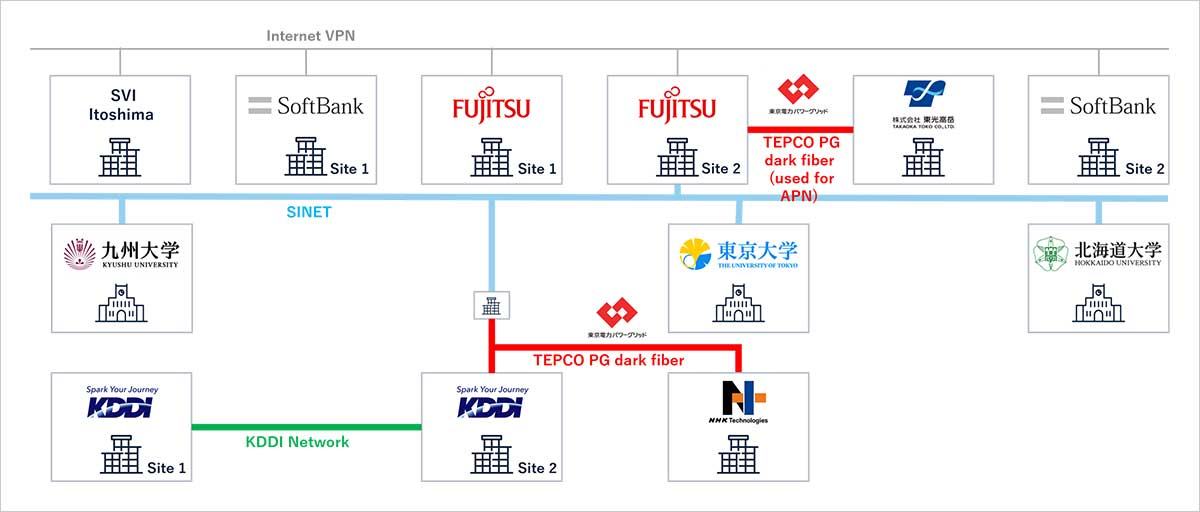
There are plans for a field demo to establish a wide-area communications network using Japan's Science Information Network (SINET) operated by the National Institute of Informatics alongside dark fiber owned by consortium member TEPCO Power Grid, which was originally deployed for power-system security purposes. The demonstration will also test directly connecting selected data center sections using an all-optical network.
Central to the trial is wide-area workload shift (WLS) technology in which an orchestrator collects and analyzes information about electricity supply, demand, market conditions, GPU utilization, battery storage status, and network performance. Based on these data inputs, the orchestrator determines where AI workloads should run and controls their placement.
Initial tests starting from August will see wide-area workload shifting trialed between universities in Japan. More advanced demonstrations are planned to establish real-world effectiveness of coordinating workload movement with renewable energy availability, storage batteries, and centralized orchestration. Tests are planned to continue until February 2027.
The Multi-Stakeholder Collaborative WLS Demonstration Consortium counts a dozen members, with Mesh-X responsible for overall project coordination; Fujitsu, KDDI, NHK Technologies, and Takaoka Toko providing data center infrastructure; TEPCO Holdings delivering advisory and evaluation support; and Morgenrot examining the feasibility of GPU-as-a-service to support shared compute capacity access across the distributed infrastructure.
The rest of the consortium is made up of various Japanese universities, some of which will contribute SINET connectivity and testing. The consortium intends to grow the number of participating data centers and businesses, and establish an open operational model and common interfaces which can be promoted internationally.
The Virtual Hyperscaler offers an alternative to NTT Group’s all-photonic network (APN) efforts through the Innovative Optical and Wireless Network (IOWN) Global Forum, which offers an APN designed to move huge amounts of data with minimal latency and power use.
Recent financial results saw NTT position IOWN as essential to its AI infrastructure pivot, as the Japanese telecom giant aims to move away from mobile operations.






Comments