


NTT’s all-photonics network solution received another high-performance computing (HPC) boost.
According to the Japanese giant, a joint demo demonstrated a 775 Gb/s data transfer with its Innovative Optical and Wireless Network (IOWN) All-Photonics Network (APN) technology. The test was conducted across an 800 Gb/s optical connection, representing around 97% of available bandwidth, while sustaining speeds above 750 Gb/s for several minutes.
The collaboration involved various NTT telecom arms, Japanese research giant Riken, the National Institute of Informatics (NII), and the University of Tokyo. The bodies reported approximately 20% lower network latency than SINET, NII’s academic research network, which also links the two sites. The results, they said, show that existing practical applications can make effective use of an 800 Gb/s line over long distances.
Under the hood
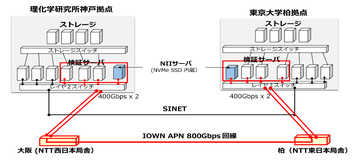
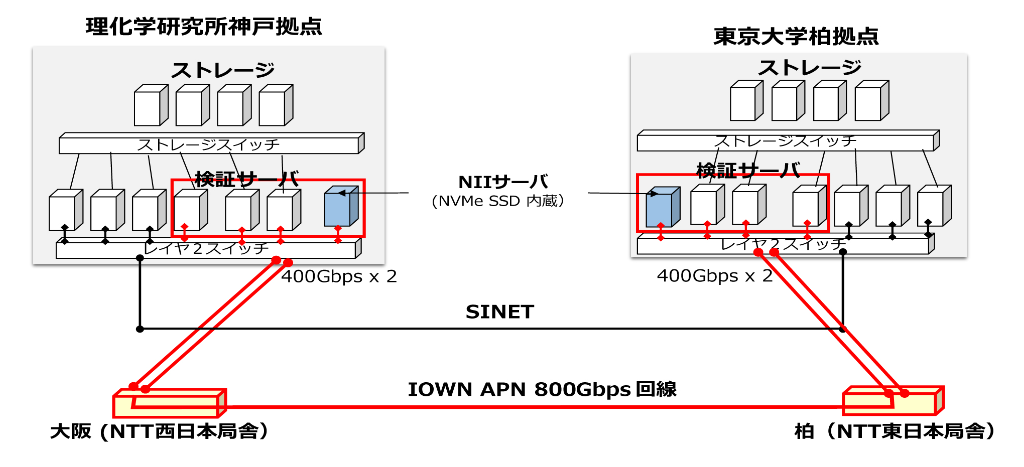
The IOWN APN demo connected the University of Tokyo's Kashiwa campus to Riken's Kobe facility, which operates several advanced computing platforms, including the Fugaku supercomputer. Two 400 Gb/s links connected an NTT West facility in Osaka with an NTT East one in Kashiwa, providing 800 Gb/s of aggregate access capacity at either end.
The architecture incorporated two practical data-transfer applications operating simultaneously. The first was the HPCI shared storage system operated by Riken and the University of Tokyo, which uses the Gfarm distributed network file system. Together, Riken and the university operate geographically distributed HPCI shared storage systems with approximately 100 petabytes of capacity each.
The second application was NII's Massively Multi-Connection File Transfer Protocol (MMCFTP), which, as its name suggests, supports multipath transfers while maintaining user-specified transfer rates regardless of communication distance. NII installed dedicated servers populated with numerous solid-state drives at both research facilities, connecting each server to its local network switch through one 400 Gigabit Ethernet interface and four 100 Gigabit Ethernet interfaces.
A diagram provided by NTT West showed that throughput fluctuated considerably during the testing period, with early bursts approaching 750 Gb/s, intermediate periods around 200-600 Gb/s, and later transfers consistently surpassing 700 Gb/s.
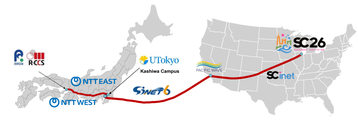
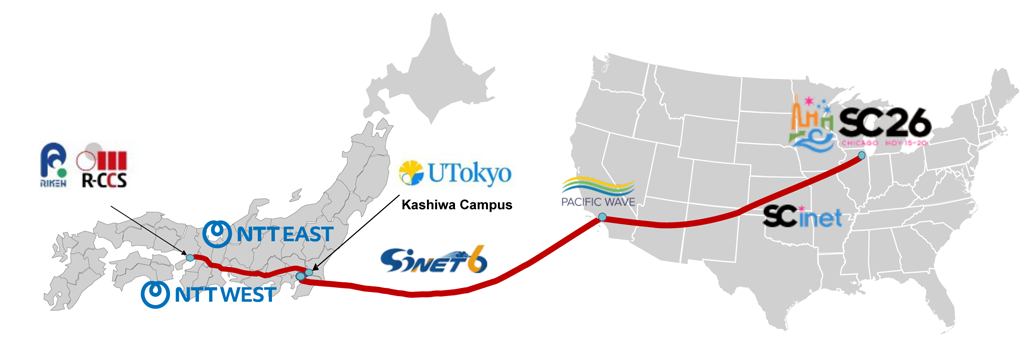
For the next stage, the researchers intend to extend the experimental environment from Japan to the U.S. and demonstrate MMCFTP transfers across an international network with at least 400 Gb/s of capacity throughout the end-to-end route. The plan will see the same facilities connected across the Pacific via SINET6 and the Pacific Wave international research networking infrastructure, leading into the Supercomputing 2026 (SC26) event in Chicago. NII described the proposed test as the first of its kind between Japan and the U.S. to use connections providing at least 400 Gb/s across the entire path.





Comments