

Optical networking is riding an AI-fueled wave of popularity that is driving opportunities from traditional scale-across connectivity toward more tightly integrated scale-out and even scale-up, a wave that is also driving the need for greater standards collaboration by those looking for a long ride.
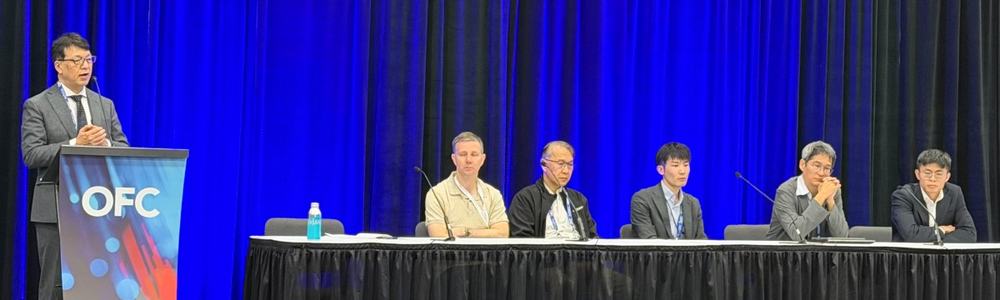
The Innovation Optical and Wireless Network (IOWN) Forum has been a long-standing stalwart in attempting to unify wide-reaching optical networking standards but has seen that noble mission subsumed by a rash of more localized efforts targeted within a data center environment that IOWN backers know they must work with in order to advance the broader cause. Progress toward that goal was central to a panel discussion at the recent OFC event, where representatives from various organizations laid out their thoughts on collaborative efforts.
One of those groups was the Open Compute Project’s (OCP) recently launched Optical Circuit Switching (OCS) subproject, which is focused on developing an interconnect system that leverages light instead of electrons to transmit data at far faster speeds.
Michael DeMerchant, senior director for Lumentum’s optical circuit switch product line and OCS subproject lead, noted that the OCS group is most likely looking to work with IOWN “in terms of standardizing the software and management interfaces for OCS to make it easier to adopt and easier to build SDN control planes around.”
Iwan Kartawira, product integration manager at iPronics and also lead of the OCS subproject, built on this, noting interest in gaining access to IOWN-developed SDN controllers.
“Then once we define the Yang models, and then whether or not we can actually collaborate together, and how to reuse this SDN controller,” Kartawira said of that interest, adding that OCS could them work with other vendors to put their internally developed OCS platforms “at the bottom of that so that the each of this SDN controller can exercise without having to basically having a translator, for example, for each one of the command that he's pushing down to the OCS layer.”
Chris Huang, EVP at Edgecore Networks, broadened his collaborative ask to both IOWN and OCP.
For IOWN, Huang asked for help in developing short- or medium-distance transceivers, which is an area Huang said has been “largely vacated” due to a lack of use cases. For OCP, Huang said there was a need to provide some guidance on best practices for SDN in data center environments.
“Even for system builders like us, usually we're not ripping into that kind of information because, especially in the packet-switched paradigm … they'll say, ‘oh, give us your switch. We'll figure it out. Don't bother us with all that,’” Huang said of that insight. “The secret sauce that we're building – optical switching – you need the SDN. You need to build the SDN, you need to know, in a sense, how the entire architect is being built, how it's being deployed, what are the use cases … all that kind of stuff. So this is really a good opportunity for the subgroup to come out and standardize some best practices in the space.”
Kazuya Anazawa, a researcher at NTT Network Innovation Laboratories and also a member of the IOWN Global Forum, did note that this SDN work has indeed been somewhat limited until now and that further clarification of that work would be beneficial.
“We currently define virtual architecture for optics-based AI clusters, so [the] next step will [be] to define … more specific implementation model should be defined,” Anazawa said, adding “this will be done by September.”
What about scale-up?
More recent efforts include the Optical Compute Interconnect’s Multi-Source Agreement group (OCI-MSA), which has support from such heavyweights as Nvidia, AMD, and Broadcom. That group, like many, wants to align open optical interconnect specifications targeted at scale-up.
Lumentum’s DeMerchant said that while that specific group is new, “it’s good that there has been an MSA come out that can try and promote some standardization as we move into the optical scale-up domain. I think that'll help the entire ecosystem.”
“The technology they picked actually lines up really well with what OCS can do,” DeMerchant continued. “They selected the DWDM (dense wavelength division multiplexing) single fiber solution, and I think the phase two is even a bi-directional solution, so that actually works really well with circuit switching. So hopefully there’s a scenario where we can collaborate in the future.”



Comments