


The wait is over: Nvidia is set to start shipping its Blackwell-powered desktop supercomputer.
DGX Spark was teased at CES under the name Project Digits before being officially unveiled at the chip giant’s GTC event in March.
Despite its $3,999 price, the system is already sold out on Nvidia’s website, with shipping due to start on October 15.
The first unit in the world, however, went to one Elon Musk. The xAI founder received the first DGX Spark in a nod to having been among the early adopters of Nvidia’s DGX-1 supercomputer back in 2016, when he was at OpenAI.
“In 2016, we built DGX-1 to give AI researchers their own supercomputer. I hand-delivered the first system to Elon at a small startup called OpenAI, and from it came ChatGPT, kickstarting the AI revolution,” said Jensen Huang, founder and CEO of Nvidia. “With DGX Spark, we return to that mission, placing an AI computer in the hands of every developer to ignite the next wave of breakthroughs.”
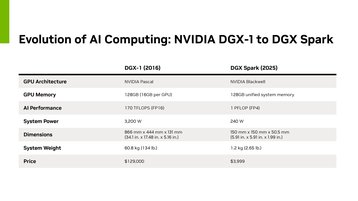
The desktop system is based on Nvidia’s Grace Blackwell architecture, featuring the GB10 Superchip, a low-key iteration of its flagship hardware. Despite its small size, Nvidia claims DGX Spark systems can deliver up to one petaflop of AI performance.
In terms of networking components, Nvidia’s ConnectX-7 network adapter provides some 200 Gb/s of network bandwidth. It also houses Nvidia’s NVLink-C2C interconnect, which the chip giant claims provides 5x the bandwidth of fifth-generation PCIe across 128 GB of CPU-GPU coherent memory.
The system also comes packed with Nvidia’s CUDA libraries and its AI software stack – all while being able to fit in an office or a lab.
Nvidia’s decision to offer a desktop offering came as the vendor said AI workloads are outgrowing the memory and software capabilities of PCs and workstations and instead forcing developers to shift work to the cloud or local data centers.
Alongside Musk, the early recipients of Nvidia’s attempts to reinvent the PC include Meta, Google, and Microsoft, as well as the open-source AI platform Hugging Face.
Select research organizations were also given early access to support their AI development.
“DGX Spark allows us to access peta-scale computing on our desktop,” said Kyunghyun Cho, professor of computer and data science at the NYU Global Frontier Lab. “This new way to conduct AI research and development enables us to rapidly prototype and experiment with advanced AI algorithms and models – even for privacy – and security-sensitive applications, such as healthcare.”
One notable change to its GTC unveiling was the price: Back in March, Nvidia said the lower-end DGX Spark would retail for around $3,000.
Partner systems will be available from Asus, Dell Technologies, and Lenovo, among others.
No word was offered on the soup-ed up iteration, DGX Station. The higher-end unit features the new B300 Grace Blackwell Ultra Desktop Superchip and is meant to be capable of some 784 GB of coherent memory, with Nvidia touting it for the most intense AI workloads.







Comments