


NTT Advanced Technology (NTT‑AT) claimed success with a wireless laser communication system used at the site of Japan's historic Matsuyama Castle.
The tech commercialization arm of NTT Group deployed Centauri, a point-to-point optical link device designed to transmit data over long distances using laser light instead of traditional fiber cables or radio frequencies. Developed by Singapore’s Transcelestial Technologies, the solution aims to make high-speed connectivity easier and faster to deploy, especially in areas where laying fiber is neither practical nor cost-effective.
In the case of Matsuyama Castle, found in Matsuyama City within Japan’s Ehime Prefecture, there was the added consideration of historical preservation. Regional cable TV and telecom operator Ehime CATV wished to strengthen its Wi-Fi service and video transmission at Matsuyama Castle with consideration for the heritage and history of the surrounding area.
The Centauri service was used to connect the castle, located on the top of a small hill about 130 meters above sea level, to the Ehime CATV building at the foot of the mountain, approximately 800 meters above sea level. According to NTT, Centauri’s 10 Gb/s model allows communication of up to 1.8 miles (3 kilometers), while the 25 Gb/s model allows communication ranging up to 0.6 miles (1 kilometer).
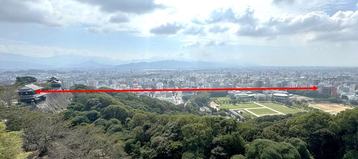
The deployment, which was monitored for one month between November and December last year, was described as the first commercial use of laser wireless networking in Japan. Following the project’s success, Ehime CATV will use the service in tourist destinations such as Shiroyama Park, as well as expanding to wider areas including remote island locations.
NTT-AT, which has been offering Centauri since last year, added it would be exploring the solution for permanent communications applications such as between buildings, and also temporary communications covering tourist destinations, event venues, and sites of historic preservation, alongside rapid restoration of networks in disaster response scenarios.
Elsewhere in laser-based communications, Alphabet spin-out Taara this week released a chip capable of transmitting data at speeds up to 25 Gb/s. By shrinking down free-space optics into a fingernail-sized piece of hardware, the chip is placed into a module with an improved form factor, enabling it to mount on simpler structures such as monopoles and rooftops.
This month also saw Taara launch its Lightbridge Pro optical switching solution that combines the firm's standard 20 Gb/s full-duplex offering with an integrated switch capable of providing either radio frequency or fiber backup. The solution aims to add fiber-like speeds for carrier-grade networks supporting applications including data centers, urban densification, and enterprise applications, reportedly offering 99.999% carrier-grade reliability.




Comments