


Fewer than half (46%) of IT leaders admit they have the observability tools needed to gain actionable insights from across their network infrastructure.
A survey from NetOps solutions provider BlueCat and EMA of some 250 IT executives found that despite spending hefty sums on a variety of tools, network engineers are still struggling to plug the gaps in their existing network observability capabilities.
According to the findings, the biggest issues identified were limited scope, with 25.1% of respondents unhappy that available market tools were unable to monitor specific aspects of their network, such as the public cloud or secure access service edge architect.
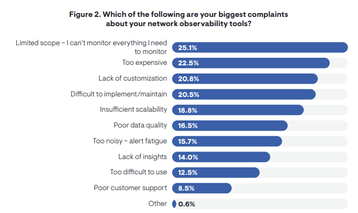
Cost was also a major concern behind adoption, with 22.5% of IT leaders admitting that the price vendors place on how many devices and how much traffic they can afford to monitor has significantly impacted their ability to get the best out of their network observability tools.
Another major concern identified was the sheer quantity of available offerings. The report found that 87% of network operations teams are using multiple network observability tools – with specialized tools employed for specific use cases, like SD-WAN for their WAN overlays.
Some 46% said they were using two network observability tools, while 23.4% said they were using three. Just 12.7% said they were using only one.
That fragmentation of tooling, while requisite for specific use cases, is compounding observability issues, with a lack of customization and difficulty to implement and maintain ultimately straining engineering resources.
The survey found that the integration of such tools beyond basic data sharing leads to more successful deployments.
Of the respondents whose tools employed minimal integration capabilities, some 25% said they had experienced unsuccessful deployments. That figure dropped to zero among respondents who said their observability tools featured high or deep integration across multiple layers.
AI & alert fatigue
Some 15.7% of the 252 respondents said that their biggest complaint about their network observability tools was alert fatigue, with engineers unable to minimize noise and focus on events that require immediate attention.
Earlier findings from EMA found that just 29% of alerts from network observability tools are actionable. Data overload from cascading alerts was among the major pain points outlined during the recent DCD Compute event, where Vishnu Acharya, Uber’s head of network infrastructure for EMEA, admitted that the company is struggling with “too much data” on telemetry in its network.
BlueCat and EMA’s survey echoed those sentiments, suggesting network teams were spending too much time triaging alerts and not enough time solving the problems buried within the noise.
The findings reveal that network observability tools are more mature when they advance beyond static thresholds – though engineers require data enriched with contextual analysis to speed up reaction times.
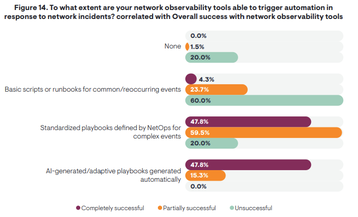
The report suggests that AI could help to provide that context.
BlueCat and EMA found that of the network teams with AI-generated or playbooks that are generated automatically, some 47.8% admitted complete success with network observability tools, while 15.3% said they’d seen partial successes. Zero said they have seen failures.
Conversely, of the network teams with standardized playbooks defined by NetOps, 20% of respondents saw failures with their network observability tools, a figure that would rise to 60% for those just using basic scripts or runbooks.
“Too many teams are still firefighting with fragmented, reactive tools,” Paul Gray, BlueCat’s SVP of engineering for its LiveNX, LiveAction, and LiveAssurance platforms, explained. “Automation and AI are no longer optional. Achieving secure, high-performing networks requires that NetOps teams retool with intelligent and automated solutions that help them more effectively move from problem to solution or avoid issues altogether.”





Comments