

Meta has offered a glimpse into its new architecture for its biggest AI clusters.
Dubbed Non-Scheduled Fabric (NSF), it represents a parallel approach to Meta's existing Disaggregated Scheduled Fabric (DSF) architecture unveiled last year.
Its new iteration, however, is specially designed for the tech giant’s largest clusters. Detailed during the Open Compute Project Foundation (OCP)’s Global Summit 2025, NSF runs entirely on shallow-buffer, disaggregated Ethernet switches to provide low round-trip latency.
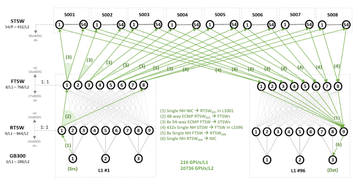
Despite being split across three tiers – which traditionally have caused engineers headaches due to their complexity – Meta contends that its NSF architecture supports adaptive routing for effective load-balancing. This enables its engineers to ensure optimal GPU utilization when running AI workloads while also minimizing congestion.
In a blog post published this week, Meta engineers revealed NSF would form the basis for Prometheus, Meta’s upcoming multi-gigawatt clusters scheduled to come online in 2026.
NSF is set to be a part of Meta's dual-fabric strategy, with its DSF architecture also receiving an overhaul. In the 12 months since its unveiling, Meta revealed DSF now provides interconnects for up to 18,432 XPUs.
The new dual-stage DSF architecture now supports non-blocking fabric, enabling interconnect between a larger number of GPUs in a cluster. Meta engineers detailed they used it to build out clusters of 18,000 GPUs “at the scale of entire data center buildings.”
New Ethernet switches and optics
OCP 2024 also saw Meta introduce Minipack3 Ethernet switches based on Broadcom’s Tomahawk 5 and Cisco’s Silicon One G200. This year’s global summit saw the tech giant unveil yet another 51T Ethernet switch, the Minipack3N.
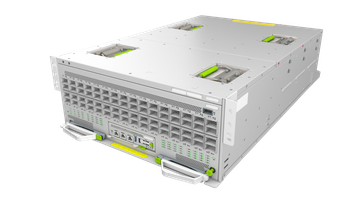
This latest switch is based on Nvidia’s Spectrum-4 switching ASIC. Designed by Meta engineers and manufactured by Accton, the Minipack3N leverages the same system design as the Minipack3 and will be used to support both frontend and backend data center fabrics.
Meta also unveiled a series of new pluggables, including the 400G DR4 OSFP-RHS optics – its first-ever DR4-based pluggable for AI host-side network interface card connectivity.
The social media giant also revealed the 2x400G FR4 LITE, which is capable of supporting fiber links up to 500 meters. There’s also the 2x400G DR4 OSFP optics, which is focused on the switch side, providing connectivity from host to switch.
Meta joins ESUN
Meta has also lent its voice to the new networking-focused OCP working group, ESUN.
Alongside the likes of AMD, Cisco, and Nvidia, Meta engineers will work to create open designs and standards around Ethernet for AI scale-up.
The tech giant said its current contributions to ESUN include providing best practices and lessons learned from deploying Ethernet fabrics in its own data centers.
“We invite engineers, developers, and industry partners to join us and the OCP community in shaping the next generation of networking hardware for AI,” a company statement reads. “By working together and sharing ideas, we can accelerate the development of open, future-ready AI infrastructure that benefits the entire industry and supports the demands of tomorrow’s technologies.”



Comments