


Hewlett Packard Enterprise (HPE) unveiled its new Cray GX5000 supercomputing platform that enables cluster operators to run different configurations in the same rack.
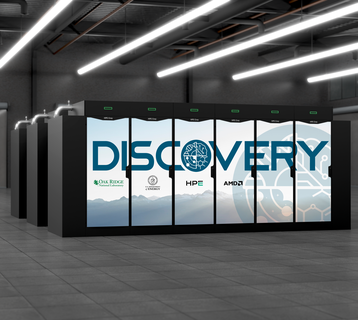
The GX5000 is set to power Discovery, one of two new supercomputers for the U.S. Department of Energy’s (DOE) Oak Ridge National Laboratory (ORNL). The other system, dubbed Lux, will be a cluster set to power AI and machine learning (ML) workloads, which the lab will offer as a “flexible, multitenant AI cloud platform” for both training and inference.
Supporting the GX5000 is the K3000 storage solution developed by Intel’s former Distributed Asynchronous Object Storage (DAOS) team. The engineering unit was acquired by HPE in late 2024, though the two parties collaborated on DAOS software projects years prior.
According to HPE, the optional storage addition provides GX5000-based systems like Discovery with 300% more input/output operations per second (IOPS) per storage rack compared to Frontier's ClusterStor E1000 systems (75 million vs 18 million IOPS per rack). Discovery is the successor to ORNL’s formerly world-beating system, which at the time of writing is the second-most powerful supercomputer in the world, behind HPE's El Capitan.
AMD hardware will power Discovery, including the chip giant’s Instinct MI430X GPUs, which are set to launch in the in the second half of 2026, along with its forthcoming 6th-generation EPYC processors, currently codenamed “Venice,” and its Instinct MI430X GPUs.
“When we built Frontier for Oak Ridge National Laboratory and ushered in exascale, we achieved the pinnacle in supercomputing history and a triumph for the U.S.,” said HPE CEO Antonio Neri explained. “We are proud to build on that leadership innovation and strong public-private partnership with the U.S. Department of Energy, ORNL, and AMD to build Discovery and Lux, accelerating the next era of scientific discovery and AI innovation.”
More Slingshot news due ‘in a bit’
On the networking front, HPE confirmed that its Slingshot remains integral to the GX5000, providing the interconnectivity for the new Discovery supercomputer.
In a press briefing, Trish Damkroger, SVP and GM of HPC and AI infrastructure solutions at HPE, confirmed that its Slingshot 400 series is now shipping to early customers.
The Slingshot 400 was unveiled in December 2024, offering 400 Gb/s speeds, twice the line speed compared to previous generations. It also features automated congestion management, meaning cluster engineers can run sizable workloads while the hardware dynamically adjusts network traffic to maintain performance and reduce packet losses.
Damkroger indicated further Slingshot generations are in development but declined to provide specifics, noting only that announcements would come “in a bit.”
“Slingshot is still a core part of our portfolio,” Damkroger told SDxCentral during a press briefing. “It is a differentiator because it has low latency and unique congestion management, and it’s the networking that’s part of our three exascale systems, so we will continue to support it.”
The GX5000 platform, however, supports partner fabrics, including both InfiniBand (Quantum-X) and the Ethernet-based Spectrum X from Nvidia for reference designs.
Breaking uniform blade designs


While networking updates were few on the ground this time out, arguably the most significant architectural shift in the GX5000 is its ability to support mixed cabinet configurations – a clear departure from the rigid uniformity found in Frontier’s EX cabinets.
“One of the things that is unique in this GX5000, we will have the ability to mix and match,” Damkroger explained in a press briefing. “With the EX, you had to have the same load across each one of the blades. With the new pump design, we’re going to be able to mix and match, having mixed cabinets, which is definitely something that our customers have been interested in.”
The pump design is what HPE has dubbed a “side pump,” a redesigned liquid cooling system that is essentially a miniature cabinet next to the system, allowing cluster managers to control water flow rates independently per blade.
“The cooling pump is designed to be more compact and can be placed on the side of the system, instead of in the middle," Damkroger explained. "Each pump is going to have redundancy to ensure that there's an always-on operation.
“We have also optimized the cooling so that the users can control the water flow rate to differentiate," Damkroger added. "So instead of basically every single blade having the same, you can optimize it depending upon what the need is for that blade and what's running.”
Beyond allowing operators to run multiple workloads across different blades, there’s a cost reduction element, also, with the side pump supporting water temperatures up to 40°C (104°F), which HPE said eliminates the need for additional chillers and refrigerators.
The GX5000 also shrinks the physical footprint by 42%, moving from a 95-inch double-wide cabinet to just 53 inches, while delivering 127% more compute performance per slot.
HPE expects its first GX5000 deliveries in early 2027.
Comments