


The intense demand for networking optics looks to have attracted attention from scammers, as Hewlett Packard Enterprise (HPE) warned fake Aruba-branded transceivers are circulating that are convincing enough to pass visual inspection.
In a Support Center notice published earlier this week, the networking giant said it had received reports from customers whose newly purchased Aruba-branded transceivers were having issues, either failing to connect with its virtual operating system (PVOS) switches or simply not working.
Instead of a hardware flaw, though, those unsuspecting customers purchased fakes. The fakes are described as convincing enough to carry authentic-looking Aruba branding and serial numbers.
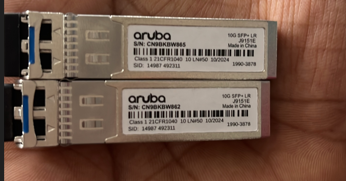
Despite passing visual inspection, the transceivers are betrayed by the switches themselves. HPE notes the counterfeit units report a different part number than what's printed on the physical label. The label states 1990-3878, but the switch reports 1990-3883. When checking validation using the HPE Validate Security ID (SID) portal, an error stating "the provided SFP Security ID is showing as invalid" appears.
The incident appears not to be isolated, as HPE's notice mentions “multiple customers” were affected. However, the exact number of customers that have been duped is not specified in the notice.
HPE in written responses to SDxCentral noted it was "tracking this issue closely, but our line of sight into scope and timeframe is dependent upon customers reporting to us. Once we learned of the issue, we published a notice to customers in the HPE Support Center to alert them and advise on steps to remediate."
As for its SID validation process, the vendor explained it "employs a multilayer validation approach to identify and prevent counterfeit transceivers beyond the SID portal. This includes validating authenticity across three layers: serial number (identity), firmware signature, and runtime behavior (CLI output). Counterfeit transceivers typically fail in one or more of these areas, most commonly in behavioral inconsistencies observed via CLI."
HPE also noted it's continuing "to investigate this, and all, reports of counterfeit parts as they arise. Counterfeiting is a problem endemic to the technology industry and not unique to HPE due to the long, complex nature of supply chains and prevalence of third-party sales. When we discover an issue, we communicate with those impacted and work to remediate."
The demand for optics is at an all-time high amid the AI infrastructure buildout, with scaling cluster sizes requiring faster transmissions and lower latency than traditional copper wiring can provide.
Goldman Sachs research puts the total addressable market (TAM) for optical networking hardware on track to grow by a factor of nine, reaching $154 billion. TrendForce analysis, meanwhile, projects the global market for AI-focused optical transceivers alone to rise by 57% this year from $16.5 billion in 2025 to $26 billion in 2026.
Supply constraints, however, are hampering access to hardware, which makes network buyers and procurement teams seeking transceivers tasty targets for scammers.
Joining memory hardware on the scarcity watch are electro-absorption modulated lasers (EML), used in data center switches.
Not all optics are equally at risk, however. Multimode short-range (SR) optics used in product lines targeting campus uses – like the 10G transceivers shown by HPE to, in fact, be fake – rely on laser lines, which currently enjoy generally healthy supplies.
UPDATE: This story has been updated with a response from HPE.







Comments