


Hewlett Packard Enterprise (HPE) has updated its Nvidia computing line with AI-driven software integrations and new servers.
On the software side, HPE is integrating the latest Nvidia AI stack into HPE Private Cloud AI, its AI platform co-developed with the chip giant.
The update adds support for Nvidia’s latest Llama Nemotron models for agentic workflows. Unveiled in March, the reasoning models provide building blocks for AI agent delivery via Nvidia’s inference microservices. These slot into existing platforms, with three tiers aligned for edge devices, highest throughput on a single GPU, and multi-GPU servers.
On the physical AI side, HPE Private Cloud AI now includes the Nvidia Cosmos Reason vision-language model, as designed for robotics and any device supporting computer vision, such as those found in autonomous vehicles (AVs).
The Nemotron updates come as agentic AI increases its foothold in the networking space, with Cisco recently suggesting to SDxCentral that the impact of numerous AI agent deployments could strain network bandwidths equivalent to “80 billion” users.
Examples include Extreme Networks, which has released an agentic AI-focused network visualization offering, while generative AI Intel spinout Articul8 recently unveiled a Network Topology Agent capable of creating a queryable graph of entire networks.
HPE itself has added agentic AI management capabilities to its GreenLake platform to provide root-cause analysis for network issues, though created without Nvidia's involvement.
“HPE is committed to empowering enterprises with the tools they need to succeed in the age of AI,” said Cheri Williams, senior vice president and general manager for private cloud and flex solutions at HPE.
“Our collaboration with Nvidia continues to push the boundaries of innovation, delivering solutions that unlock the value of generative, agentic, and physical AI while addressing the unique demands of enterprise workloads.
"With the … expanded capabilities in HPE Private Cloud AI, we’re enabling organizations to embrace the future of AI with confidence and agility.”
HPE ProLiant updates
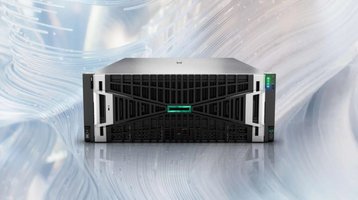
The latest hardware additions to the Nvidia AI Computing by HPE portfolio include a pair of ProLiant configurations built on Nvidia’s AI-native Blackwell architecture.
Designed for air-cooled data centers, a DL385 Gen11 model supports up to two RTX PRO 6000 Blackwell Server Edition GPUs, and is designed for 2U-size mainstream servers.
The previously announced 4U DL380a Gen12, meanwhile, is built for denser inferencing and vision workloads, scaling to eight RTX PRO 6000 GPUs in a 4U configuration.
The launch marks the first time ProLiant systems have featured Nvidia’s Blackwell-class GPUs. Coupled with HPE’s iLO 7 management chip, the systems include a silicon root of trust to verify firmware integrity, a secure enclave to isolate sensitive workloads, and quantum-resistant firmware signing.
For network teams, these features potentially mean the servers can be introduced without overhauling existing security frameworks, helping maintain trusted device management, protected control planes, alongside secure data handling across both data center and edge environments.
“Enterprises need flexible, efficient infrastructure to keep pace with the demands of modern AI,” said Justin Boitano, vice president of enterprise AI at Nvidia.
“With Nvidia RTX PRO 6000 Blackwell GPUs in HPE’s 2U ProLiant servers, enterprises can accelerate virtually every workload on a single, unified, enterprise-ready platform.”




Comments