


Hewlett Packard Enterprise (HPE) continues to fold its Juniper Networks assets into operations, with its latest push touted as the first public unveiling of combined products targeted at telecommunication operators looking at controlling network functions more efficiently and getting those networks ready to better support AI use cases.
The basis for the updates is a pair of new Juniper routers designed to help unblock growing AI-derived networking pinch points.
Julius Francis, senior director of product marketing for HPE’s Routing Infrastructure Solutions business, prefaced the news by explaining that interconnection becomes increasingly vital as AI begins to move outside of the four walls of a data center.
“As AI is becoming distributed, that puts network at the center of performance, and the bottleneck is not at the GPU anymore, the fabric connecting everything becomes [that bottleneck],” Francis said.
HPE’s latest attempt in uncorking that impediment begins with the PTX12000, which Francis described to SDxCental as being targeted at compute intense environments like hyperscalers and neoclouds. It includes 800 Gb/s (800G) port density on a 1.6 Tb/s (1.6T)-ready platform, and the ability to scale to 345.6T with an eight-slot variant and 518.4T with a 12-slot version.
“These are the pioneers of these, building that network parameters, interconnecting these AI batteries, they're also distributing the inference edge and they need to be connected back to the central training sites. They want to move all the data,” Francis said. “What this is providing is that needed density and the throughput in that form factor so that would give them the space and power efficiencies and also the deep buffering capability.”
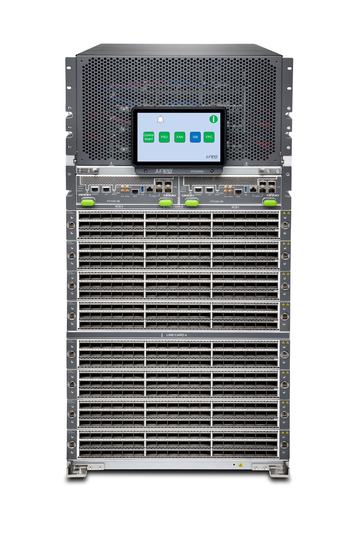
Francis claimed that rivals offering similar capabilities in the market are doing so “in a bigger footprint and also in an older chassis, a legacy chassis, so that will lead to when they need the next whatever density they have to rip-and-replace. With ours, there’s no redesign, it's just simply bringing the new line cards.”
The PTX launch also builds on HPE’s Juniper integration efforts, which received an update at the vendor’s Discover Barcelona event late last year. This included new MX routers and work with Nvidia to bring its accelerated compute and Spectrum switching.
The second new router is the the Juniper PTX10002 line of fixed form routers targeted at more resource constrained locations. These include a two rack-unit (2U) footprint for AI network fabrics, with support for 28.8T or 14.4T throughput and flexible multirate 100G, 400G, and 800G port options.
HPE also updated its Juniper Routing Director with model context protocol (MCP) capabilities that will allow users to more easily connect an AI copilot and use agentic AI for workflows. Francis noted this is an important step toward managing self-driving networks.
“Self-driving networks is our destination, and AI is how we're going to accelerate it,” Francis said.
Compute density and cost efficiency
HPE also updated its compute offerings with a new ProLiant chassis and server package that provides up to twice the fronthaul network bandwidth and a 20% core count increase over previous offerings. That is a 2U form factor with support of 72 CPU cores and 24 available network ports per server, with up to two servers supported per chassis.
This infrastructure can now also support Juniper Cloud Native Router, which allows for consolidated RAN and compute functions into a single server. For operators this can eliminate routing hardware at cell site locations, which can lower capex and provide energy efficiency for lower opex.
Francis explained that this software platform is now offered as a “virtual container” integrated “right into both the servers.”
“What that means is we can now collapse the routing and compute layer, [which] means less devices to manage, lowering the operational complexity, and bringing site and space efficiencies,” Francis said.
HPE’s Financial Services division also released a new financing option that allows for no payment during the first 90 days of a deal followed by lease payments over the next nine months at 1%. The financing option is available for HPE’s networking, compute, storage, and software portfolio.
Continued Juniper integration
These updates also continue HPE’s Juniper integration, and as noted by Francis is “a powerful statement that we have committed to networking and how we are also with that AI network fabric, built out with HPE compute, storage, we have a full-stack, end-to-end solution.”
“This is the one company who has leadership in all that different compute, networking, and security, so customers can trust us now that we have the full end-to-end portfolio,” Francis added.




Comments