


Amid all the talk of Mythos and the widening arsenal of AI tools at the disposal of threat actors, Google debuted an automated security system it claims can help users stop AI-powered threats.
Google AI Threat Defense leans on technologies gained from the cloud giant’s acquisitions of Mandiant and Wiz to fight fire with fire – scanning vulnerabilities in applications, APIs, and identities in live environments, as well as code.
Through Wiz infusions, the offering can unearth potential threats while also simulating attacks to identify and validate exploitable paths, including at the application layer.

The Cybersecurity Supplement
Inside the frontline against AI-driven cyber warfare
On the code front, the offering also taps Google’s flagship Gemini models to augment its code remediation capabilities. When a code flaw is unearthed, AI Threat Defense creates an apparent “prioritized map of real business risk” that developers can use to improve patching.
Beyond solely a defensive mechanism, Google pitches its AI Threat Defense offering as a strategic asset for businesses, claiming it can help nail down strategies for safely retiring legacy products or aid the roll out of AI-generated patches “without overwhelming engineering teams.”
“By combining the contextual risk prioritization of Wiz, the code remediation capabilities of CodeMender, the intelligence of Gemini, and the frontline expertise of Mandiant, we provide the architecture needed to match the speed of the adversary,” Francis deSouza, COO and president of security products at Google Cloud, wrote in a blog post.
The preview of Anthropic’s Mythos model earlier this year, with its apparent ability to fix security vulnerabilities at unprecedented scale, was the latest in a series of stark reminders that the proliferation of AI has completely upended the constant push-pull between threat actors and defenders.
Beyond simply triaging security operating center (SOC) alerts or identifying code issues alone, the need for actual AI-ready security tools and tricks to stop the expected onslaught of attackers with the power of ever-improving technologies at their fingertips.
Google’s $32 billion deal for Wiz looks to fill that market need while providing tighter control over the security stack around its own platforms.
The recently acquired brand acts as the effective discovery component in AI Threat Defense, providing users with the means to automatically unearth issues from across their stack to form a “live exposure map.” Wiz’s now Google-infused AI tools can identify risks that “traditional testing often misses,” deSouza claimed.
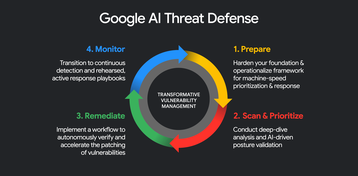
Rather than relying on a sole Gemini or Wiz AI model under the hood, Google said its new cybersecurity feature packs multiple underlying systems for specific uses, like a lighter-weight offering for broad, continuous coverage, and more expensive frontier models are left to focus solely on the highest-risk applications.
The multimodel approach can “enable organizations to find the largest collection of vulnerabilities while managing costs, enabling you to scan, remediate, and maintain your software assets on an ongoing basis," deSouza explained.
Ecosystem partners like Accenture, Deloitte, and PwC are already using the platform, which the hyperscaler claimed adds “expertise” to users through tailored security workflows and continuous management.
“Together, we will help ensure that threats are being identified at machine speed and being automatically remediated, aligning with your organization's specific operational and compliance requirements,” deSouza added.






Comments