


Equinix unveiled an AI-augmented iteration of its flagship Fabric platform to make it easier for enterprises to launch their networking infrastructure.
The Equinix Fabric Intelligence acts as an AI-infused operational layer for managing network infrastructure, providing means for engineers to dynamically respond to workload changes in network operations.
The colocation giant’s offering introduces what it described as “smart automation” for connection management, enabling distributed systems to run reliably without the need for repeated manual interventions.
Where such bottlenecks would typically delay network performance, Equinix said the offering can reduce deployment timelines “from weeks to minutes.”
“Fabric Intelligence turns infrastructure from a constraint to a competitive advantage by enabling our customers to spend less time managing complexity and more time moving their business forward,” Equinix Chief Business Officer Jon Lin said following the launch.
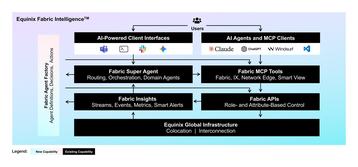
Hot on the heels of debuting its Distributed AI Hub platform, Equinix’s latest reveal centers around a suite of “AI-native solutions” that lets enterprise engineers use natural language and agentic workflows to support projects.
Among the offerings is the Fabric Super Agent, which lets staff use prompts via Slack, Microsoft Teams, or the Equinix Customer Portal to autonomously manage their networks – eliminating the need to navigate through interfaces or understanding APIs.
It also offers a suite of AI-ready management tools aimed at simplifying the means to connect AI systems to existing network infrastructure. Additional model context protocol (MCP) servers allow users to tap offerings like Claude Code, OpenAI Codex, and Cursor to ensure user-preferred agentic systems are available.
“All enterprises are focused on leveraging AI to transform their business, but most lack the infrastructure needed to deploy it at scale in ways that drive their growth,” Lin added. “As agentic AI matures and inferencing applications proliferate across the enterprise, networking infrastructure needs to be faster and more flexible than ever before.”







Comments