


Dell added full lifecycle support for AI workloads to its data platform, while deepening its Nvidia partnership.
Dell’s AI Data Platform – which was designed to support Nvidia’s AI Data Platform reference architecture – has been updated with a new unstructured data engine, co-developed with AI-driven search company Elastic.
The offering builds on the Elasticsearch tool, which allows firms to create custom AI apps using structured and unstructured data.
Underpinning the engine is built-in GPU acceleration to speed up search and retrieval across large content stores. It sits alongside Dell’s federated SQL layer for cross-source queries; a scale-out processing engine for heavy transforms; and high-throughput, AI-ready storage.
This enables both structured and unstructured data to feed AI workloads via a unified stack, allowing for full AI lifecycle support from data ingestion through to inference.
Queries can be run through Nvidia retrieval microservices (NeMo Retriever), as integrated into Dell AI Data Platform earlier this year.
“Fast, accurate, and context-aware access to unstructured data is key to scaling enterprise AI,” Elastic Chief Product Officer Ken Exner explained. “Elasticsearch vector database at the heart of the Dell AI Data Platform's unstructured data engine [brings] vector search and hybrid retrieval to a turnkey architecture, enabling natural language search, real-time inferencing, and intelligent asset discovery across massive datasets.”
Dell hardware updates
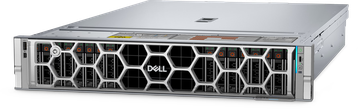
On the hardware side, Dell updated its PowerEdge R7725 and R770 systems with Nvidia’s RTX PRO 6000 Blackwell Server Edition GPUs, as designed for air-cooled data centers. In addition, the R7725 server is Dell's first 2U server platform to integrate the Nvidia AI Data Platform reference design.
With AI-native Blackwell chips in both systems, Dell is touting the servers as primed for both agentic and physical AI deployments, enabling support for Nvidia’s latest Llama Nemotron models for agentic workflows.
Unveiled in March, the reasoning models provide building blocks for AI agent delivery via Nvidia’s inference microservices. These slot into existing platforms, with three tiers aligned for edge devices, highest throughput on a single GPU, and multi-GPU servers.
On the physical AI side, Dell cites support for the Nvidia Cosmos Reason vision-language model, as designed for robotics and any device supporting computer vision, such as those found in autonomous vehicles (AVs).
The servers sit alongside this week's upgrades by Hewlett Packard Enterprise (HPE) to its ProLiant servers, which feature Nvidia’s Blackwell-class GPUs for the first time, deepening the chipmaker's networking footprint.
HPE Private Cloud AI was also updated with support for Nemotron models to deliver agentic workflows, broadening Nvidia's network software reach.
Dell and HPE’s Nvidia software updates come as agentic AI increases its foothold in the networking space. Extreme Networks released an agentic AI-focused network visualization offering, and generative AI Intel spinout Articul8 recently unveiled a Network Topology Agent capable of creating a queryable graph of entire networks.
Nokia has also entered the space, while HPE has deployed agents without Nvidia involvement via its Aruba and GreenLake platforms.
Cisco recently suggested to SDxCentral that the impact of numerous AI agent deployments could strain network bandwidths equivalent to “80 billion” users.




Comments