

Ciena introduced a line of compact optical transport platforms aimed at supporting edge networking and metro access networks.
The Waveserver E-Series includes two models, the Waveserver E10 and Waveserver E200, designed to offer scalable and flexible transport capabilities in a small form factor.
The Waveserver E10 is a one-rack-unit form factor (1-RU) with 10 client ports and two line ports. It is intended primarily for multisite aggregation of 1-gigabit Ethernet (1GbE) services and operates at a 24-watt power consumption, making it suitable for locations with limited power availability.
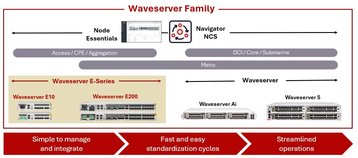
The Waveserver E200, also 1RU, provides higher capacity with 24 client ports and two line ports, supporting services ranging from 1GbE to 100GbE, as well as OTU2/2e and OTU4 optical transport unit rates.
The model uses Ciena’s WaveLogic 5 Nano (WL5n) coherent pluggables, which support transponder/muxponder applications leveraging 100G-200G dense wavelength division multiplexing (DWDM). It also provides add-drop-mux metro ring applications, suited for aggregating multirate services in metro locations.
With its multi-aggregation focus, the E200 could help end users handle bottlenecks arising from the demands of AI-accelerated traffic.
Both platforms are built around WL5n technology, which supports coherent pluggables from 100G up to 400G. Ciena noted this enables flexible and efficient optical transport over metro and regional networks.
The E-Series also includes a software layer with open APIs, allowing for integration with existing network management systems and supporting more prompt provisioning of new services during AI traffic surges.
Vimal Pindoria, Ciena’s European director for routing and switching business development, in an interview at this week's Connected Britain event said he expects AI to add capacity onto the network, with traffic coming from the enterprise to a first point of aggregation such as the edge or metro level, and onward to the cloud.
“Edge is where compute meets the network. With AI a lot there’s a lot more compute happening closer to the user. So if you're not allowing access to compute very close to the user, you're going to start having bottlenecks," Pindoria said. “It could be central, it could be an edge location, but it's really about preparing yourself for what could come. And that really means having an adaptive network.
"Take your enterprise with huge amounts of data. It's got to go through a load of training in the model, and then once that model is trained, it's going to be pushed back down again. So there will be a mammoth amount of capacity needed only for a limited set of time, and then taken back down,” Pindoria added.
More in The Distributed Infrastructure Channel
-
-
-

Episode Is data AI’s biggest bottleneck?


Comments