


A Toronto-based startup launched a chip with a custom AI model printed directly onto silicon, which its founders say can run inference workloads more than 100-times faster than conventional graphics processors and at a fraction of the cost.
Taalas says its Hardcore AI architecture embeds model parameters directly into a custom chip instead of executing them in software at runtime. Conventional AI accelerators move model data between memory and compute during inference, creating latency and power overhead. The company aims to remove that bottleneck by baking the model into silicon.
The company has built its first product, the HC1, around Meta’s Llama 3.1 8B model. Taalas says the HC1 can generate responses in under 200 milliseconds, processing around 14,000 tokens per second. The company claims this is about 10-times faster than Cerebras Systems’ wafer-scale engine, which it describes as the fastest inference platform currently available, and around two orders of magnitude faster than GPUs. The HC1 draws around 200 watts, compared with the 120 to 600 kilowatts typical of a GPU rack.
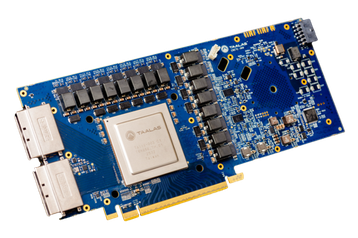
The trade-off is specificity; each chip is designed for a single model, meaning any significant model update requires a new fabrication run. Taalas says it has addressed this by working with Taiwan Semiconductor Manufacturing Co. (TSMC), the world’s largest contract chipmaker, on a process that requires changes to only two metal layers rather than a full redesign, allowing a customized chip to be completed in about two months. By comparison, a processor such as Nvidia’s Blackwell can take up to six months to fabricate.
Taalas CEO Ljubisa Bajic described the debut model as a beta release intended to let developers explore what becomes possible when large language model (LLM) inference runs at sub-millisecond speed and near-zero cost, noting that it is not aimed at the leading edge.
The company announced last month that it had raised $169 million in its latest funding round, bringing its total raised to more than $219 million from investors including Quiet Capital, Fidelit, and veteran chip investor Pierre Lamond. Despite the raise, Taalas says it has spent only $30 million reaching this launch point, leaving more than $170 million in reserve.
The announcement comes weeks after Nvidia all but acquired inference chip rival Groq. Financial terms of the licensing deal were not disclosed; however, CNBC reported the deal could be worth about $20 billion, a figure neither company confirmed.
Bajic, previously founder of the now Jim Keller-led AI chip company Tenstorrent, founded Taalas two and a half years ago, alongside COO Lejla Bajic and CTO Drago Ignjatovic. Both Tenstorrent alumni with long careers at AMD. The 25-person company has filed 14 patents covering its architecture.
Taalas plans to offer both inference-as-a-service and direct hardware sales. A mid-sized reasoning model is expected later this spring, with a frontier-class chip targeting deployment by the end of 2026.





Comments