


Broadcom is looking to shake up high-performance computing (HPC) with Tomahawk Ultra, an Ethernet-based switch the company tells SDxCentral will leave rival networking interconnects in the rear view mirror.
Designed to get the best out of tightly coupled AI clusters, Tomahawk Ultra is capable of supporting up to 77 billion packets per second to power high-intensity workloads.
Tomahawk Ultra follows the release of its Tomahawk 6 switch, released back in June. Where the 6th edition is designed for a mix of scale-out and scale-up, the new Ultra is optimized for both HPC and scale-up, with the hardware capable of achieving 250ns of switch latency at 51.2 Tbps of throughput.

The latest Tomahawk chip reduces Ethernet header overheads from 46 bytes down to as low as 10 bytes, meaning users can augment clusters through sub-microsecond switching.
The chip also features a lossless fabric technology, which Broadcom said eliminates packet drops during high-volume data transfers. Through its Link Layer Retry (LLR) feature, the chip detects link errors and automatically retransmits data packets, avoiding drops and helping those using it to power AI training to keep their workloads running uninterrupted.
Network operators that snapped up Tomahawk 5s can switch out their existing hardware for Tomahawk Ultra, as the hardware is pin-compatible, allowing for a simpler upgrade process.
“Tomahawk Ultra is a testament to innovation, involving a multi-year effort by hundreds of engineers who reimagined every aspect of the Ethernet switch,” said Ram Velaga, SVP and general manager of Broadcom's Core Switching Group.
“This highlights Broadcom’s commitment to invest in advancing Ethernet for high-performance networking.”
Shaking up scale-up with Ethernet
With the launch of the Tomahawk Ultra, Broadcom wants to take advantage of the increasing shift away from Nvidia’s InfiniBand-based scale-up interconnect system, NVLink.
The chipmaking giant touted that, when deployed on its Scale-Up Ethernet (SUE), the Tomahawk Ultra can scale to 1024, compared to NVLink’s 72.
Broadcom’s barrage against the rival scale-up system marks the latest in an industry increasingly looking to move away from the proprietary interconnect system.
The likes of AMD, with its Pensando Pollara chips, and Marvell’s Fastlinq adapters are Ethernet-based, with operators looking for open solutions to avoid being solely locked into Nvidia’s ecosystem.
Research firm 650 Group suggests that Ethernet will become the dominant fabric for the AI networks market, a segment that it suggests will be worth more than $30 billion by 2028.
Even Nvidia itself is getting in on the act, to a certain extent. At last year’s Computex event, the chipmaking giant unveiled its Spectrum-X Ethernet networking platform, with plans to launch related products in the future.
Broadcom, though, has been gunning to beat InfiniBand for some time, with Pete Del Vecchio, the company’s product line manager for Tomahawk switch products, telling SDxCentral that the company’s engineers were initially skeptical about achieving the same latency levels with Ethernet.
“Ethernet that works with any endpoint,” Del Vecchio explained. “Hyperscalers want to have the ability to have fungible interfaces on their GPU. With Ethernet, a hyperscale can interconnect their cluster appropriately to support a particular customer’s needs.”
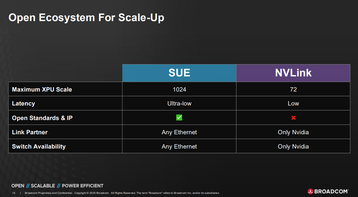
With the Tomahawk Ultra being open, Broadcom contended its system works with any endpoint to provide that flexibility while also surpassing InfiniBand's performance.
Broadcom even took a swipe at another effort looking to surpass InfiniBand: UALink.
Created as part of a consortium that includes AMD, Intel, Meta, and Hewlett Packard Enterprise, and most recently, Apple and Alibaba, UALink aims to be an open industry standard for interconnecting AI hardware.
Del Vecchio expressed doubt at the rival standard’s desire to achieve 300-nanosecond latency goals, arguing UALink is not competition for Broadcom’s SUE in the short term.
He said, “If you want to take a UALink, or Infinity Fabric, you can tunnel that over Ethernet to get the latency of Tomahawk Ultra today. Is there a need for a technology that doesn’t fit into your ecosystem, doesn't fit into the rest of your network?”
“Even though our initial vision was just to beat InfiniBand on HPC, we see that Ethernet is going to win out for next-gen scale-up, and this is going to shake things up. Even where other scale-up systems slam Ethernet, saying you can’t achieve these latencies, we have a proof point that’s available [and] deployable today.”
In addition to the networking chip, Broadcom doubled down on its scale-up system with SUE Lite, an optimized version of SUE designed power power-hungry and area-sensitive accelerator applications.




Comments