


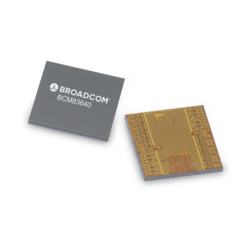
Broadcom debuted the Taurus BCM83640, a specialized chip to power next-generation optical transceivers.
The digital signal processor (DSP) is designed to enable 1.6 Tb/s (1.6T) pluggable modules and support 400 Gb/s (400G) per lane (G/lane), double the bandwidth of previous generation interconnects. This is designed to meet spiraling connectivity demands in AI data center networks.
The BCM83640 uses intensity modulation direct detection (IMDD) to reduce signal loss and boost performance. This is where data is encoded by varying laser intensity via a laser driver embedded directly into the three-nanometer (nm) die rather than using more complex coherent optics, eliminating the need for a separate chip.
“Taurus pushes the IMDD technology envelope into 400G/lane, further reducing power and advancing our roadmap of cost-optimized solutions for connectivity in AI and cloud networks,” Vijay Janapaty, VP and GM of Broadcom’s Physical Layer Products Division, explained.
Broadcom’s DSP launch comes at a crucial time for the already highly competitive optical transceiver market. The insatiable hyperscaler demand for faster networks to power their equally insatiable AI efforts has led to a scramble to supply modules from 400G to 800G, and now 1.6T.
Cisco, Ciena, and Naddod offer 1.6T optics, with Marvell joining the crowd just this week. Broadcom’s Taurus BCM83640 looks to enable more optics designers to get in the action, with a compact 3nm design, meaning modules capable of handling intense performance needs while using much less power.
Broadcom even suggests the BCM83640 can provide the underlying foundation for the next-generation of optics speeds beyond 1.6T: the highly anticipated leap to 3.2T.
Janapaty said the Taurus DSP’s doubled throughput per lane will help it enable that generational leap.
“We expect more than 100 million units of 1.6T and 3.2T optical transceivers to be shipped over the next five years, with close to half of these using 400G optics,” Vladimir Kozlov, CEO and founder of market research firm LightCounting, noted. “High-speed optical interconnects are essential for operation of AI clusters. Doubling of the lane rates has been a proven strategy to keep up with the bandwidth growth, and it is great to see the first 400G per lane solutions becoming available.”
Broadcom has provided sampling access to the new chip to customers and partners.





Comments