


Broadcom is continuing to build out its AI infrastructure offerings with new solutions aimed at breaking performance barriers across end-to-end workloads.
The chip giant unveiled Tomahawk 6 Davisson, a co-packaged optic (CPO) Ethernet switch that offers a staggering 102.4 Tb/s.
Co-packaged optics targeting AI network demands
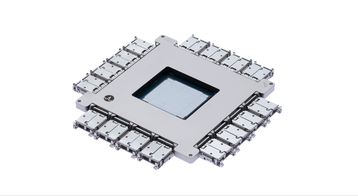
The new Tomahawk 6 Davisson brings together the firm’s StrataXGS Tomahawk 6 silicon with sixteen 6.4T silicon photonics engines.
Optics are now even closer to the switch silicon, a move Broadcom claims provides dramatic link flap reductions and power loss in Davisson, enabling it to power high-speed interconnects for AI clusters.
Davisson is Broadcom’s third-generation CPO, having debuted its Gen 1, Humboldt, back in 2021. The vendor is already working on its fourth-generation CPO, which features 400G per lane.
Ahead of the launch of Davisson, Manish Mehta, VP marketing and operations in Broadcom’s optical systems division, told SDxCentral that the two prior iterations helped it to build upon the original value proposition for its CPO line.
“When we launched CPO, it was pre-AI, and it was for front-end compute. At the time, customers were telling us, ‘The power is a little high on optical transceivers, and we see a point at which we think signal integrity is going to be a challenge,” Mehta explained. “But with the migration to AI training in scale-out networks being the dominant application for optical interconnects. The industry has learned that the forgiveness that front-end cloud compute had for a link flap event doesn’t exist in the back-end.”
Further validation for its CPO line then would come just a week prior to Davisson’s launch, with tests by one of the biggest names in tech showing its CPO switches ran for one million cumulative hours without a single data drop.
Meta trialed generation two of its CPOs, dubbed Bailly, at one of its specialist hardware testing facilities, where it ran continuously without any link flaps – a brief connectivity disruption typically caused by an issue with the switch itself.
For a firm like Meta, such a drop could have a severe impact on the performance and run-time of AI models, with synchronous training across thousands of GPUs meaning that one disruption would impact the entire process.
For Broadcom, meanwhile, the data from Meta’s tests validates development in technology that it claims represents a step change, taking AI networks to the next level.
“When we started the (CPO) platform, we had to go out against modules and show we have lower power, cost because of the integration, and reliability,” Rajiv Pancholy, director of hyperscale strategy and products in Broadcom’s optical systems division, told SDxCentral. “Now, whether they believe us or not on power, we’ve got data from Meta that shows a 90% training efficiency gain that you get by using CPO.”
“Bailly wasn’t designed with AI; it was conceived pre-AI training being the dominant use case,” Mehta added. “We have migrated this to being purpose-built for AI … we [also] have done a lot of work in improving the fiber density, because if you go from an FR4 [transceiver] to a DR [transceiver], you need to double the number of fiber connections - going from four fibers to eight per port.”
The Meta tests build on what Mehta described to SDxCentral as an evolving platform, marked by growing technical understanding among decision makers, as well as an expanding roster of partners eager to see how CPO technologies develop further.
“Maturing that ecosystem over three generations, with both our initial lead partners and a growing list of additional partners who are getting very excited about what CPO can deliver to networks,” Mehta said. “I think we're seeing really positive momentum on the broader investments for CPO.”
The Broadcom executive suggested that the improvements don’t show any signs of stopping either, adding: “[Meta] saw 65% savings on, a 5x improvement in serviceable failures over pluggables. That’s a pretty big deal. I don’t think it's going to stop here.
"We're still in the early days of CPO, so there's still things we got to work out, but if the baseline is 5x better, then having line of sight to the kind of failure rates we've always targeted for CPO - which is that it's going to be as reliable as traditional silicon chips - at least [that] is within reach.”
In terms of availability, Davisson devices are in early access for customers and partners. Broadcom is working with TSMC on its CPO-focused packaging architecture dubbed Compact Universal Photonic Engine (COUPE) to bring the offering to life.





Comments