


California-based startup Blaize is expanding into Asia through a new $120 million partnership with infrastructure provider Starshine.
Under the 18-month agreement, Starshine will deploy Blaize’s Graph Streaming Processor (GSP)-based hardware to support smart city projects across markets including India, Indonesia, Japan, South Korea, and China. This will tap Blaize's AI chips that are targeted at edge computing use cases.
The partnership plans to shift AI inference workloads to the edge, reducing latency, energy consumption, and total cost of ownership. The rollout will initially focus on urban infrastructure, with plans to expand into other sectors.
“Asia represents a $112 billion opportunity for next-generation intelligent systems, and inference is leading the charge,” Dinakar Munagala, co-founder and CEO of Blaize, noted. “Our hybrid AI platform is designed to deliver the efficiency, flexibility, power, and support for multimodal workloads to meet this surge, especially at the edge.”
Blaize was founded in 2011 by Munagala, Ke Yin, and Satyaki Koneru, who spent a combined three decades in Intel’s graphics division, with the latter also previously serving as a senior design engineer at Nvidia. It went public earlier this year following a special purpose acquisition companies (SPAC) arrangement, which saw it merge with BurTech Acquisition.
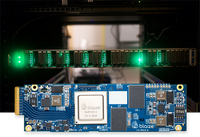
The startup’s GSP hardware is designed to power inference engines for AI clusters, processing local data like sensor streams at the edge. Blaize’s flagship Pathfinder X1600E system-on-chip (SoC) can run AI inference models at lower power consumption than traditional GPU-based systems.
Its team-up with Starshine sees the startup looking to expand its geographical reach, with the pair targeting sectors like smart city surveillance, retail and security, and agriculture technology across APAC.
The startup’s hardware is already powering AI workloads in smart city solutions in South Korea as part of a partnership with the Chungbuk Institute of Science and Technology (CBIST).
“Hybrid AI is no longer an experiment; it’s infrastructure,” Teng Ma, chairman of Starshine, explained. “This partnership gives us the technology and capability to meet surging demand across Asia for real-time, localized intelligence.”





Comments