


Google Cloud teamed with Amazon Web Services (AWS) to essentially offer scale across for users of cloud services from the two hyperscalers.
Currently in preview, the multicloud management solution conjoins Google Cloud’s Cross-Cloud Interconnect with the new multicloud service of AWS Interconnect through a “transport” resource in the former, the configuration of which is accepted in the latter.
The configuration is MACsec-encrypted with a key provided by Google. The connection it enables is then connected via AWS' long-standing Direct Connect Gateway (DXGW) resource, which allows connections between on-premises networks to multiple virtual private clouds (VPCs) across different AWS Regions.
Google’s managed resources in the setup are made up of virtual local area network (VLAN) attachments and cloud routers, which pass through CCI ports and then, under encryption, into DX ports to then pass onto the Amazon side into AWS’ private virtual interface (VIF) and DX router provisions.
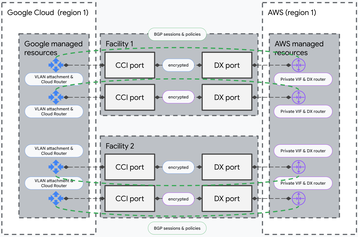
The cross-cloud connectivity service is launching in areas such as Northern Virginia, Oregon, London, and Frankfurt, with more global expansion on the cards, while API specifications are available on GitHub.
Early adopters such as Salesforce touted the service's use for AI workloads, with Google citing Forbes research that 82% of IT professionals and cloud engineers anticipate AI services will increase the demand for multi-cloud networking due "to the scarcity of specialized accelerator resources and the availability of diverse AI agents across different vendors."
Google and Amazon also claimed the partnership would do away with the long-lead times traditional with physical infrastructure management, to be replaced by a managed, cloud-native experience for users.
"This innovation allows you to build on-demand connections in minutes between your Google Cloud and AWS VPCs, transforming multicloud networking from a complex build into a simple, managed service,” claimed Himanshu Mehra, director of product management for Google Cloud.
"By defining and publishing a standard that removes the complexity of any physical components for customers, with high availability and security fused into that standard, customers no longer need to worry about any heavy lifting to create their desired connectivity,” said Robert Kennedy, VP of Network Services, AWS.
“Integrating Salesforce Data 360 with the broader IT landscape requires robust, private connectivity. AWS Interconnect - multicloud allows us to establish these critical bridges to Google Cloud with the same ease as deploying internal AWS resources, utilizing pre-built capacity pools and the tools our teams already know and love. This native, streamlined experience – from provisioning through ongoing support – accelerates our customers' ability to ground their AI and analytics in trusted data, regardless of where it resides,” said Jim Ostrognai, SVP Software Engineering, Salesforce.
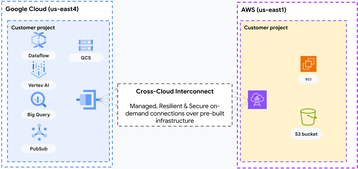
According to a Google blog, the project was initially spearheaded by AWS before the tech giant reached out to its hyperscale rival for collaboration.
The Google announcement was also the official launch of AWS Interconnect - multicloud, which proffers private connections to other cloud service providers (CSPs). Following Google Cloud as its first launch partner will be Microsoft Azure at some point later in 2026. The feature is currently available in preview across five AWS Regions.
It comes joined by another preview in the form of AWS Interconnect - last mile, a collaboration with Lumen allowing users to connect branch offices, data centers, and remote locations to AWS through less steps.
The service aims to simplify complex network configuration including border gateway protocol (BGP) peering and VLAN configuration, allowing users to dynamically scale bandwidth from 1 Gb/s to 100 Gb/s through the AWS console with the promise of "zero down-time maintenance" and MACsec encryption enabled by default between AWS Direct Connect and partner devices.
The new services come after AWS bolstered its domain name system (DNS) service, Amazon Route 52, with the promise of 60-minute recovery time objective (RTO). This is achieved via accelerated recovery for managing public DNS records, providing access during failover issues to key Route 53 API operations, and possibly offering solutions during long-term outages such as the one which infamously affected AWS worldwide in October.






Comments