

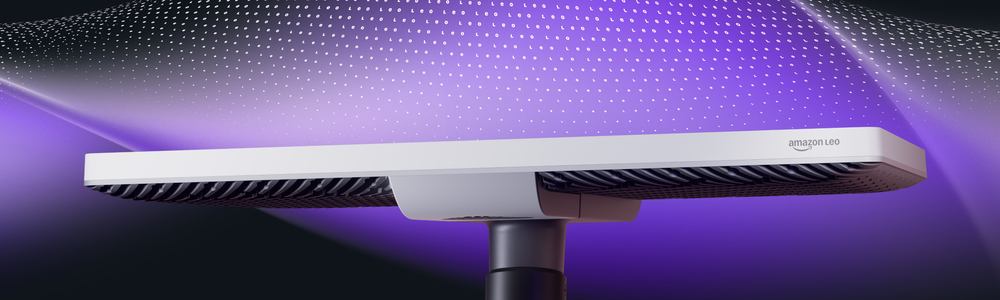
Amazon has revealed the final design of Leo Ultra, its enterprise-grade satellite terminal capable of supporting download speeds of up to 1 Gb/s.
The terminal, unveiled shortly after the firm rebranded its satellite venture from Project Kuiper to Amazon Leo, is a full-duplex phased array antenna, meaning it can transmit and receive simultaneously at the same frequency.
Featuring a custom silicon chip and Amazon's proprietary radio frequency (RF) design and signal processing algorithms, the Leo Ultra is the largest of the firm’s three satellite terminals, and can support upload speeds up to 400 Mb/s.
It can be affixed to buildings or placed on the ground, and is used to connect to one of the 150 low-Earth orbit (LEO) satellites that Amazon currently has in orbit – though several thousand more are planned in the coming years as it looks to take on SpaceX’s Starlink.
“From our satellite and network design to our portfolio of high-performance phased array antennas, we’ve designed Amazon Leo to meet the needs of some of the most complex business and government customers out there, and we’re excited to provide them with the tools they need to transform their operations, no matter where they are in the world,” said Chris Weber, VP of consumer and enterprise business for Amazon Leo.
In addition to supporting fast uploads and downloads, Amazon claims its new Leo satellite service features “advanced networking capabilities.”
Alongside the ability to simultaneously upload and download data, AWS customers can use Leo to directly transfer data to their cloud workloads in either AWS Transit Gateway or AWS Direct Connect Gateway, through a point-and-click interface on the Amazon Leo web console, allowing users to securely connect to their hosted environments with little latency.
Leo allows enterprises and telecoms providers to establish private network interconnects (PNI) through colocation facilities. Essentially, PNIs allow users to create direct connections to remote parts of their infrastructure, a process that Amazon claims takes days with Leo Ultra, where it previously took weeks or months.
The service also comes packaged with network management tools and encryption across the network, with Amazon marketing it as a way to support critical business applications as well as potential government entities.
Amazon further claims its high-end terminal is capable of withstanding high and low temperatures as well as rain and strong winds.



Comments