

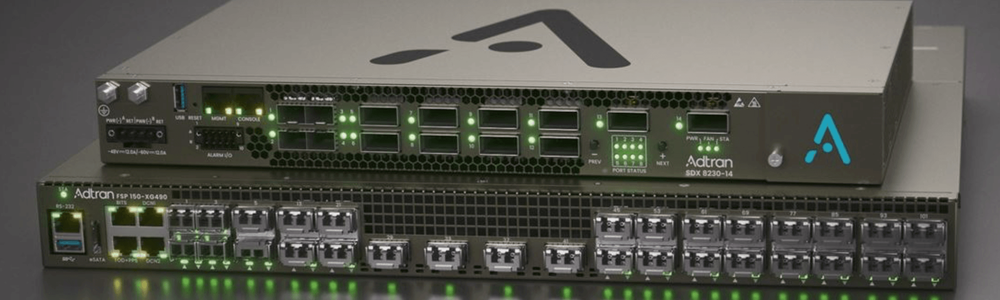
Network equipment vendor Adtran released "Terabit-class" edge routers capable of supporting network speeds up to 400 Gb/s.
The new releases span the FSP 150 and SDX 8000 series, with the SDX 8230 touted as supporting high-density aggregation from 10 Gb/s to 400 Gb/s in compact form factors designed for edge and regional aggregation. The FSP 150-XG490 router targets higher-density environments, promising to bring 400 Gb/s aggregation closer to access networks and mobile backhaul sites without the need for oversized core routers.
The routers integrate directly with Adtran’s FSP 3000 IP OLS and ZR/ZR+ coherent optics for 400 Gb/s packet-based edge transport expansion beyond native reach in supported configurations. Adtran said the combined approach simplifies network design by reducing the need for standalone transponders and streamlining edge architectures as capacity grows.
Automation and orchestration tools aim to deliver unified control and automation across edge routing and optical transport, enabling edge-based routing services. These include multiprotocol label switching (MPLS), segment routing, Ethernet VPN (EVPN), and internet protocol virtual private network (IPVPN) within a disaggregated architecture.
“Operators are being asked to deliver more bandwidth and support faster deployment timelines, all while managing rising operational complexity and keeping costs under tight control,” Adtran CTO Christoph Glingener explained in a statement. “What we see across the industry is a growing mismatch between real-world edge requirements and the oversized platforms traditionally used to meet them. Operators are being forced to juggle too many boxes, too many port types, and too much inventory.
"Our Terabit edge routers let them scale intelligently, by simplifying deployments, stripping out unnecessary hardware, and reducing dependence on proprietary architectures while maintaining consistent operations as the network grows. The result is a cleaner, more streamlined edge that delivers capacity where it’s needed at significantly lower expense,” Glingener added.
IDC recently predicted that AI use cases will spur edge computing spend to nearly $378 billion by 2028. As covered in the inaugural issue of SDxCentral magazine, this will mainly be driven by AI inferencing, the process where a trained machine-learning (ML) model generates predictions and outputs from new input data.






Comments