

AMSTERDAM – What a difference a decade makes. Back in 2016, Cisco was drastically shifting its business model from selling traditional networking equipment to focus on software and subscriptions.
After languishing in the early 2010s as it sought to recapture the magic that saw it on top of the world during the dot-com bubble, Chuck Robbins took the reins to drive away the gloom and drive Cisco toward hyperconverged infrastructure (HCI) and collaboration tools.
In 2026, Cisco has shifted once again to become a platform-centric company, buoyed by demand for infrastructure to support AI buildouts that culminated in the networking giant’s stock price surpassing its infamous dot-com bubble peak.
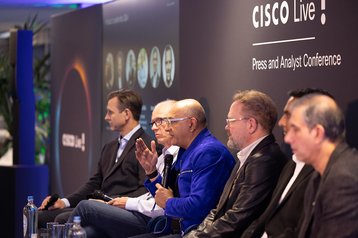
The only gloom for the vendor today, it seems, was the miserable weather in Amsterdam for the EMEA leg of its annual continental Live tour. In the dry of the venue, then, the only blue on show was the striking royal jacket donned by CPO Jeetu Patel as he made a bold claim: “We’re the Apple of infrastructure.”
“I think we're a full-stack company,” Patel said during a press briefing at the event. “If we were just a software company, we wouldn't be as effective. If we were just a hardware, we wouldn't be as effective. But the fact that we make everything from the silicon to the systems to the software to the platform, and all of that works together.”
According to Patel, the case behind the company’s recent rise is a “world-class team” and “extreme and obsessive clarity of the fact that we're going to be a platform company.”
“We can't be wishy washy about it, we had to make sure that we could communicate it to our employee base that we're going to be a platform company, and this is what we're going to do,” he explained. “That then it took a while, but it had to happen because otherwise we just looked like a holding company that had 251 acquisitions and a bunch of other teams that just individually operated by themselves, and they wanted their own fiefdom.”
Patel went as far as to say those employees not willing to prioritize changes to support the platform pivot “wouldn't be around.”
“I don't like calling companies families, because I don't think we are,” he said. “I think it's like a sports team where everyone earns their keep, and if you don't, then you're out, and someone else is in. But we're very, very tight-knit, and we're making sure that we're passing the ball and relying on each other.”
The promise and pitfalls of platform plays
Following its day-one reveals in Amsterdam, Cisco’s stock price rose by just 1%, but that was still a price-to-earnings multiple of 21-times that of calendar estimates from analysts at William Blair, showing the networking giant’s ongoing growth shows no signs of slowing.
“Cisco continues to benefit from an enterprise refresh cycle in networking and expanding AI revenues,” the analyst brief reads. “That said, we believe persistent competition across its core networking and security portfolios is likely to challenge Cisco’s ability to sustain current levels of growth.”
But immediate financial takeaways, deeper strategic, and competitive challenges around Cisco’s platform play remain. Bola Rotibi, chief of enterprise research at CCS Insight, told SDxCentral that the vendor’s shift on display in Amsterdam was “a long time coming.”
“When you think about [Cisco’s] evolution over the years, they have been centralizing the platform, and commonalizing," Rotibi said. "And in fact, they have done what Salesforce and ServiceNow and everybody else has done and that’s the way forward.”
Rotibi noted that the potential real danger with Cisco’s approach is that everyone is talking about an AI and agent-focused AI stack.
“What was missing is that they are not going to be the only agentic AI stack. And the challenge for a lot of organizations is, how do I manage all the various other agentic AI stacks that are coming in? Because you've got the hyperscalers talking about their agentic AI stack, and ServiceNow,” Rotibi said. “You've got to have a story of how you work with your partners and where you work in that stack. And that story hasn’t changed because it's the same thing you had to do when you were doing cloud and service-oriented architecture.
Cisco made some strides to appease Rotibi’s concerns around partners prior to EMEA Live with the launch of its revamped 360 partner program. The analyst told SDxCentral that the networking giant, along with many other players, are going to be looking at working closely with a small, close-knit group of strategic partners to come and go depending on the use case – a “roving band of partners” as the analyst put it.
Rotibi also noted Patel’s leadership as a catalyst for Cisco’s latest evolution, saying the CPO has “smashed some heads” so the company’s leadership is all working together and collaborating on a “unified story.”
“For me, the pillars are there, the foundations are there. But Cisco has always had a good foundation. I think it could punch above its weight a lot more,” she added.
Boldness from the top
This year's Cisco EMEA event will be the last to take place in Amsterdam, with regional president Gordon Thomson telling press, “We’ve outgrown Amsterdam.”
Some 21,000 attendees were on site – Cisco’s largest EMEA event, according to the exec – but the networking giant doesn’t look to be resting on its laurels and wants more growth.
“I think it's great to make bold claims,” Thomson told SDxCentral in reference to Patel’s Apple comparison. “If you're not prepared to stand up and make a bold claim, what's the point in being in the game?
During his keynote a day prior, Thomson talked a lot about time and went as far as to describe it as one of the vendor’s most precious assets, adding: “Right now, every second, every minute, every hour has never presented us with greater opportunity to win.”
For Cisco’s presentation in EMEA, time looks to have been a benefit, with stock prices some 300% higher than in 2016.
Thomson put that growth down to a push from the man behind the claim, saying, “I think what [Patel] has brought back to the table is the boldness and the belief in the organization that we can be the best. For too long in this organization we didn't believe we could be the best.
“For many of the years I've been in this organization, you had a hope that we could be better, but we never believed we could be the best, and we're not going to be arrogant, but we're going to be the best, and that's the game," Thomson said.
Beyond confidence in executive messaging, Steven Dickens, CEO and principal analyst with HyperFRAME Research, noted that while Patel's blue Tom Ford jacket might seem trivial, it represents "a new confidence from Cisco, a new way of stepping into their role in the industry and positioning themselves that we've just not seen."
"They've always been a bit more infrastructure and lower down the stack,' Dickens told SDxCentral. "What [Patel] has infused into his product management team, and we got this from Thomson too, is a level of confidence, and that's manifest in how they go to market."
A decade seems to have made a difference, with execs on site expressing belief that Cisco’s got what it takes to succeed. Only time will tell.







Comments