


For decades, networks have been built on the same fundamental principle: dedicated hardware appliances for each network function. Need a firewall? Buy a box. Need load balancing? Purchase another proprietary device. This approach has, however, had an unfortunate side effect, creating networks that are expensive, inflexible, and slow to evolve.
As traffic explodes and service expectations shift from months to mere minutes, this hardware-centric model has become unsustainable. Network operators face mounting pressure to reduce capital expenditure, accelerate service deployment, and scale infrastructure dynamically.
Network functions virtualization (NFV), introduced by telecom service providers back in 2012, provides a fundamental reimagining of how network services are built and delivered.
The idea is a simple one: Decouple network functions from proprietary hardware and, instead, run them as software.
NFV stormed onto the scene, promising to transform networks from static, hardware-bound systems into dynamic, software-defined infrastructure.
In the years since its introduction, NFV has evolved from a telecom-specific initiative into a cornerstone technology for cloud-native networking, enabling everything from 5G deployments to edge computing infrastructure. For network architects and infrastructure teams, understanding NFV is essential for building networks that can keep pace with modern business demands.
What is network functions virtualization?
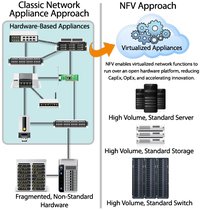
At its core, NFV is the practice of decoupling network functions from dedicated hardware appliances and running them as software on standard servers.
Instead of purchasing specialized boxes for routing, firewalling, load balancing, or traffic analysis, network operators can deploy these capabilities as virtual network functions (VNFs) running on commercial off-the-shelf (COTS) hardware.
Just as server virtualization allows multiple operating systems to run on a single physical machine, NFV enables multiple network functions to operate simultaneously on standard servers, consuming compute, storage, and networking resources only when needed.
The fundamental shift NFV brought on tipped the balance toward software-based services. Where traditional networks might require dozens of different appliance types from multiple vendors, each with its own management interface, update cycle, and support contracts – with NFV, these same functions run as software instances that can be deployed, scaled, and even retired via centralized management systems.
This architectural transformation delivers network functions through three key layers:
The NFV infrastructure (NFVI) provides the virtualized compute, storage, and networking resources
Virtual network functions execute the actual networking logic
The NFV management and orchestration (MANO) layer coordinates deployment, scaling, and lifecycle management across the infrastructure
Why virtualize network functions?
Traditional network architectures impose significant operational and financial constraints that become more pronounced as networks scale and service requirements evolve. Service providers and enterprises alike struggle with infrastructure that simply cannot keep pace with modern demands.
The hardware appliance model creates vendor lock-in by design. Organizations invest heavily in proprietary platforms that dictate not just the initial purchase but years of licensing, support, and upgrade cycles. When a new service requires additional capacity or capabilities, it means procuring, shipping, installing, and configuring more boxes – a process measured in weeks or months, not hours. Each appliance sits at a fixed location with fixed capacity, unable to adapt when demand shifts elsewhere in the network.
This rigidity translates directly into wasted resources. Hardware sized for peak loads sits underutilized most of the time. Data centers filled with specialized equipment excel at one function but cannot be quickly repurposed when priorities or hype cycles change. Power consumption, cooling requirements, and physical footprint all scale with appliance count, driving up operational costs even when the actual workload remains steady.
Complexity then compounds with scale. Managing hundreds of different appliance types, each with unique interfaces and management requirements, requires specialized expertise and constant coordination. Testing new services means procuring pilot hardware, and rolling back failures often requires another truck roll. When vulnerabilities emerge, patching heterogeneous hardware estates becomes a major undertaking.
NFV addresses these challenges by treating network functions as software workloads that can run anywhere on standardized infrastructure. Capacity becomes elastic rather than fixed. Functions can be instantiated where needed, scaled dynamically with demand, and decommissioned instantly when no longer required. Organizations gain the flexibility to test services in minutes, deploy at scale in hours, and adapt infrastructure continuously as requirements evolve.
NFV vs SDN
NFV and SDN: What's the difference?
Explore the definifive guide to the brains and tools to control the network
NFV and software-defined networking (SDN) are similar, but distinct.
Both are highly complementary approaches to network transformation, though they are often confused since they emerged around the same time and address related problems.
NFV virtualizes network functions: taking services that ran on dedicated hardware and running them as software. SDN, meanwhile, virtualizes network control, separating the control plane that makes forwarding decisions from the data plane that actually moves packets.
Put simply, NFV is about what runs in the network, while SDN is about how the network operates.
An SDN architecture centralizes network intelligence in controllers that maintain a global view of network topology and state. Network devices become simpler forwarding elements that take instructions from controllers through southbound APIs like OpenFlow. Applications and orchestration systems communicate requirements to controllers through northbound APIs, allowing network behavior to be programmed dynamically rather than configured device-by-device.

Despite their distinctions, when combined, the pair of technologies can create synergies.
SDN provides the programmable connectivity fabric that NFV needs to dynamically route traffic through chains of VNFs. When a new VNF instance spins up, SDN controllers automatically update forwarding rules to direct appropriate traffic through it. When VNFs scale or migrate, SDN adjusts network paths in real-time. NFV MANO systems use SDN controllers' northbound APIs to request network resources and connectivity for VNF deployments.
Together, they enable fully software-defined networks where both functions and connectivity are virtualized, programmable, and automated. Network operators can compose and modify services entirely through software, without physical reconfigurations. This combination has become foundational for cloud-native networking architectures, 5G core networks, and modern edge computing deployments.
The evolution toward cloud-native networking
NFV has begun evolving beyond its original virtualized appliance model toward cloud-native architectures that leverage containers, microservices, and cloud-native tooling. This shift addresses some of NFV's inherent challenges while enabling greater agility and efficiency.
Cloud-native network functions (CNFs) decompose monolithic VNFs into containerized microservices orchestrated by Kubernetes rather than traditional NFV MANO. Containers provide faster instantiation, lighter resource footprints, and more granular scaling compared to virtual machined (VM)-based VNFs. Kubernetes brings a mature, widely adopted orchestration platform with an extensive tooling ecosystem, operational expertise, and cloud provider support.
This cloud-native approach simplifies operations, leveraging standard DevOps practices and tooling that IT teams already use for application deployments. Network functions become just another workload in the broader container infrastructure, reducing the operational burden of maintaining separate NFV-specific management systems.





Comments