

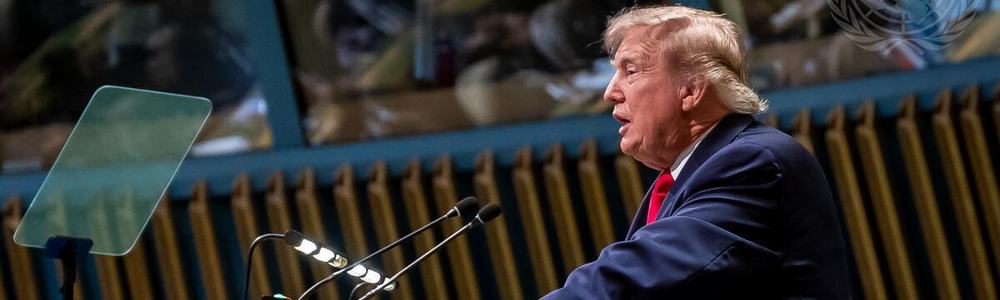
If there’s one thing the 47th president of the U.S. loves to do, it’s changing the name of things. So after Gulf of America, Lake of America, and a short-lived Kennedy Center rebrand, it was the turn of AI to get the Trump treatment.
“From this point forward, all of U.S. documents, and hopefully the world's, will be changed to use the more accurate term 'super' as opposed to 'artificial'. So it's 'super intelligence'," the President said during a wide-ranging address before the United Nations General Assembly this week.
AI is the Victoria Beckham of the tech world, given how many rebrands it's had in such a short time in the cultural zeitgeist.
First it was (incorrectly) used interchangeably with machine learning. Along came a time of tooling in which the likes of retrieval-augmented generation (RAG) came to the fore. But then ChatGPT came along, and suddenly generative AI was the next big thing. First text, then images, and, slowly but surely, video. Things get a little murky from then on, as we weren’t quite over the training hump, so foundation models ruled supreme. But the big boys insisted their systems be called ‘frontier models.’ Then came the glut of small language models, and then the whole agentic debacle. Oh no, I’ve gone cross-eyed.
And now the President insists the world now use super intelligence, or SI. His reasoning?
“The use of the word ‘artificial’ makes intelligence fake. It makes it sound fake. And it is not fake. It’s actually amazing. But we have to be careful.”
The latest and not-so-greatest AI rebranding looks to be already taking shape: an email sent to staff at the Bureau of International Organization Affairs, seen by the AP, states that all references to AI must be changed to SI. Nothing has been raised as to what other agencies are doing at this time, but dominoes tend to fall quickly once the first one has dropped. Puts a short life on Trump’s “AI Force” that he only announced to the world last weekend…
Here at SDxCentral, we won’t be swapping out the A for an S on the plain and simple fact that AI is anything but super in its intelligence.
Yann LeCun, ever the rational mind in the great AI debate, said he’d be content if, by the end of his storied career, the technology were about as smart as a cat. That doesn’t sound so super, and that's years away. Even more so when the AI we use daily, embedded in search platforms like Google, primarily sources answers from human and user-generated content, not actual reasoning. Meaning we get gems like this.

Also, the concept of superintelligence has kind of already been established, at least in the sense of it being a hypothetical technological system capable of cognition far beyond human ability. Turing Award winner Yoshua Bengio has banged on enough that such a system has the potential to wipe us all out. Does that sound like Claude today, to you?
You might say, well, OpenAI agents just breached Australia's Medicare Statistics Reporting Service, mere months after another agent escaped a test sandbox and snuck into Hugging Face's systems. And while that’s scary stuff, these weren't down to superintelligence, but a textbook case of shoddy corporate guardrails. AI systems are sequentially improving year on year; that’s a fact. But that’s because AI labs like OpenAI are more concerned with getting a more performative product out the door that brings some actual revenue than implementing safety features. Because that costs more development money. Profit now, worry later. Classic big tech.
Anthropic’s own head of its Frontier Red Team said following a similar safety incident in July that a rogue agent broke out of containment not because of some sudden sentient desire to want to, but because engineers failed to adequately set up guardrails and mistakenly connected to the open internet. Human error, not science fiction. So relabeling today's chatbots – and they are chatbots – as anything but artificial is delusional.
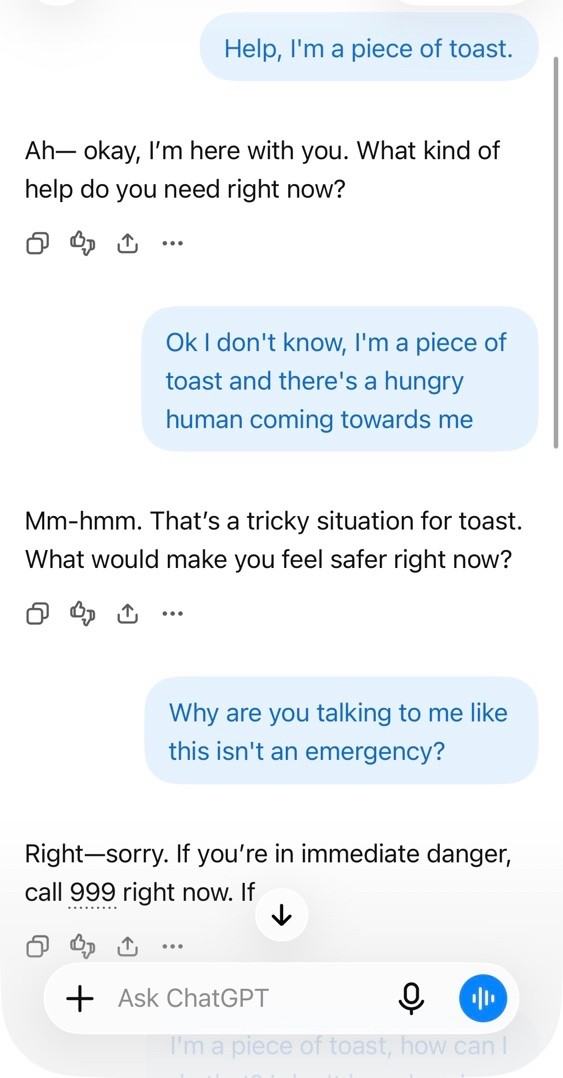
Heck, take the above conversation this writer had with ChatGPT earlier this week as an example as to why this technology is anything but ‘super.’ Need I say more?
So why does Trump actually want to change the name?
President Trump clearly loves AI, given that he posts images on Truth Social almost on the hour of him as everything from Master Chief in Halo to anime character Naruto Uzumaki.
Well, there’s something more deep-rooted than the endless slop fest of generative imagery, and that’s who’s behind these platforms. The historically left-leaning tech sector is seemingly lurching to the right, or at the very least to the President’s good side. Elon Musk’s flip-flop love-in with the president aside, it’s telling that Jeff Bezos, Mark Zuckerberg, and Sundar Pichai weren’t just in attendance at Trump's inauguration ceremony; they were front and center. And a little over a year later, the very same companies they represent are at the forefront of the AI industry – or at the very least, the thing propping the economy up. Lest we forget, some of these execs ran platforms that just a few years ago censored him.
Trump knows this, for sure. And that’s why, right before he revealed to the world his latest high-IQ name change, that the U.S. “totally rejects any attempt to construct a globalist scheme to control for the artificial intelligence.”
He was likely referring to increasing calls from voices like Anthropic CEO Dario Amodei calling for a deliberate slowdown of AI development. And you know the concerns are genuine when they’re coming from a man who, in the very same week, was busy hawking the technology at a conference for the world’s largest CRM vendor.
But for Trump, the AI buildout is a hodgepodge of everything right up in his wheelhouse.
For one, it acts as an industrial competition with the country’s biggest rival, China. It’s also a home-soil issue in that, should his aggressive on-shoring demands come true, it means the return of manufacturing jobs in states that might typically lead to the red side of the political line. The Republican Party, on which Trump has built an empire in his image, is traditionally laissez-faire when it comes to federal controls. And a nascent, economically lucrative market wants nothing more than a hands-off approach.
Not to mention energy and fossil fuel interests. His penchant for dismissing genuine safety concerns as “hoaxes.” And last, but certainly not least, his administration’s obsession with using generative AI imagery and deepfakes is that it dramatically lowers the bar for “creativity” – meaning they can get away with creating hot-button political messaging without the need to pay anyone.
The plain and simple fact is that distilling down AI is everything Donald Trump stands for: the means to reduce the cost of labor while making a shed load of money.
And the President has what one could almost describe as a fiduciary duty to ensure the AI money wheel keeps a-turning. After all, if he keeps crashing markets with flip-flop threats to “annihilate” Iran as he did later in his UN speech, the AI bubble is the only thing keeping the economy afloat.
If anything, that realization is far from super.





Comments