


It was the great scholar Ronan Keating who once said: “You say it best, when you say nothing at all.”
Such an ethereal proverb seems to have gone over the heads of those at the center of the apparent infamous money glitch popularized by the moniker of "the AI bubble." As every time one of Nvidia, Oracle, OpenAI, or [insert bubbler name here] posts on social platform X in what appears to be an effort to justify business decisions or avoid investor panic, they keep making things worse.
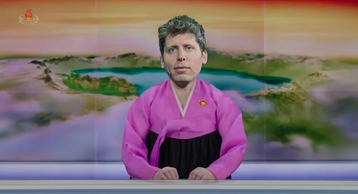
It’s akin to that famous North Korean news anchor reading out carefully written statements about how everything is fine and great, and there’s nothing to worry about, except it's Sam Altman, and there is no war in Ba Sing Se.
Subject of the latest newsflash from AI Bubble Land? The apparent stalling of Nvidia’s investment in OpenAI.
Flashback to September 2025, and Nvidia said it “intends to invest up to $100 billion in OpenAI” – it’s right here in this press release.
But along came a The Wall Street Journal report that the pledge, which was due to be finalized earlier this year, had made little to no progress, with Nvidia CEO Jensen Huang reportedly critical of OpenAI's business approach and an apparent lack of discipline.
In comments to the press this week, Huang came out and described the article’s contents as "nonsense," choosing to instead emphasize the “up to” part of that agreement, adding that Nvidia would invest in OpenAI “one step at a time.”
There’s something almost weaselly about the way he defended the wording of that original announcement. Emphasizing it defensively months later says a lot more than saying anything at all.
So then why did Oracle feel the need to come out on X with a statement saying Nvidia’s deal with OpenAI had “zero impact” on its relationship with the AI firm?
Unless they’re rattled. Unless the folks over at Oracle feel that OpenAI is so integral to its push to be a hyperscaler of relevance compared to its big three rivals that any whiff of instability requires immediate, unsolicited denial.
The problem is that nobody asked Oracle. When you volunteer to reassure the market about something that doesn't directly involve you, you're not calming fears; you’re doing the exact opposite.
It’s like when sub-orbital flight-anaut Katy Perry said: “They ask you how you are and you just have to say that you're fine when you're not really fine.” Except here, nobody asked, and Oracle's statement ended up less as comfort and more as a Streisand Effect flare gun shot into the night sky.
It’s just a flesh wound
This week was meant to be a slam dunk for OpenAI. Launch an app version of its Codex AI coding assistant and complete its latest historic funding round. What could possibly go wrong?
How about a report that OpenAI staff apparently badmouthed Nvidia’s hardware over apparent unsatisfactory inference speeds and that the "world’s most valuable startup" was looking for alternative hardware options to cover around 10% of its future inferencing needs.
Que damage control. Like the old man in "Robocop 2": “Scramble the best spin team we have.”

Top execs, including Altman himself, donned their Bubble Land newsreader robes to mount a defense of Nvidia, with the CEO gushing over Nvidia, saying, “They make the best chips in the world.”
Let’s not forget, of course, that OpenAI and the chief newsreader himself have long sought to have its own custom hardware, a dream it's finally making a reality with Broadcom.
Sachin Katti, OpenAI’s head of compute infrastructure, said it was “anchoring on Nvidia” as the core of its training and inference stack, while “deliberately expanding the ecosystem around it through partnerships with Cerebras, AMD, and Broadcom,” which he claimed would allow it to move faster and “support the explosion of real-world use cases without sacrificing performance or reliability.”
But a gargantuan fountain of gush that came out in the wake of that Reuters report again had the opposite effect, raising more questions than it answered. Like an action hero telling his buddy that he’s fine after being shot, that a bullet to the gut was “just a scratch,” it’s an attempt at obfuscation that only makes the reality of the wound more obvious.
Any man who must say 'I am the king' is no true king
Diplomacy by social media is nothing new, of course. President Donald Trump used Twitter and later his Truth Social platform to ensure his views got out to the public and media at speed. And in the wonderful world of AI Bubble Land, you only need to go back to November 2025 to see it in action when it was the turn of Nvidia.
The so-called Team Green’s efforts saw it widely mocked for claiming it was “delighted” by performance results showcased by Google in the wake of its seventh-generation Ironwood TPU reveal that month.
So why then would the darling feel the need to express delight over a rival’s performance, only to then say: “Nvidia is a generation ahead of the industry – it’s the only platform that runs every AI model and does it everywhere computing is done.”
There are a lot of feelings to unpack there. Maybe a little bit of smugness. Perhaps a little bit of jealousy. Some might even go as far as to say fear? After all, Nvidia is at the top. It’s going to have everyone and their dog nipping at its heels. What kind of message does it send to investors, those who stuck through the chip drought of the pandemic to see its portfolios soar, when every time a new rival chip drops, you feel the need to remind the world, "Hey, I’m still No.1!"
I’ll leave you with an excerpt from Game of Thrones, S03E10:






Comments