

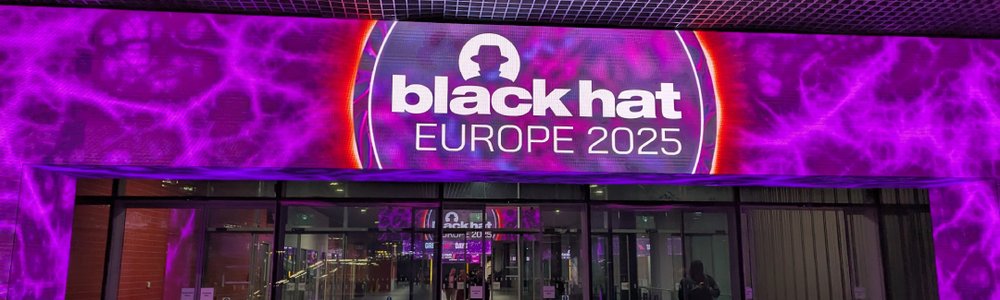
Black Hat Europe 2025 came to town in London this week, and looking around the various vendor stalls confirmed my suspicions that cybersecurity is cooler than ice cold.
Cybersec is synonymous with edgy imagery and cyberpunk visuals these days. The arguable leader here is Torq, an automated security orchestration, automation, and response (SOAR) firm that’s all neon colors and heavy metal, He-Man-esque imagery.
I’ve been onto the business since seeing them at the launch of Kyocera Cyber in London this year, with the U.S.-based Torq partnering with Kyocera’s first cybersecurity subdivision. That even an electronics stalwart like Kyocera is dipping its toe into cybersec proves there’s gold in them hills, and the U.K. may be a fruitful market after long sticking its head in the sand about getting its security together. Even the U.K. government held its first-ever cybersec conference this fall, as covered by myself for SDxCentral.
It was an interesting contrast to see the more buttoned down Kyocera Cyber branding next to Torq’s at the launch, but at Black Hat, Torq had to fight for attention away from giant robots, Blockbuster-parody booths, and the chance to get a custom expo badge with your face photoshopped onto a classic album cover of your choice. Thanks, Broadcom: that may have been the coolest thing you’ve done all year.

Torq’s rhetoric was also prevalent in its message of automating the security operations center (SOC). While automation is nothing new in cybersec, the idea of end-to-end automation is a little fresher, and with Palo Alto Networks looking to build out an end-to-end platform to end them all in network security, it’s clear which way the wind is blowing.
Arguably, Palo Alto is looking at nimbler, newer brands such as Torq and biting their style. The company’s new Cortex AgentiX suit was described as “the next evolution of SOAR and security automation as a whole,” according to an interview at launch with Gonen Fink, Palo Alto’s EVP of products for Cortex.
“We're freeing your experts to transform the SOC and focus on strategic initiatives instead of chasing the alerts,” Fink added.
And so what are those experts doing now that cybersecurity is cool and automation has freed them from their shackles? Well, what was warmly reassuring at Black Hat Europe is that they haven’t suddenly sold out and gone for populist presentations at things like these. While there was the very much fashionable AI cyber threat in some of the talks (more on that later), cyber wonks haven’t suddenly told everyone to think of better passwords and called it a night.

Instead, Black Hat’s London leg was more full of the bread-and-butter cybersec than you’d imagine after a few years of hearing about how AI is the fourth horsemen (or Skeletor) of the apocalypse. Sure, there were some cool talks about vulnerabilities in Asia’s beloved Line social media app and the world’s e-book of choice in Amazon Kindle, but like the others they spoke on the classic threats of embedded device exploitation and cryptography attacks.
AI itself came up in dryer ways than you might imagine. One talk on the corruption of large language model (LLM) inference examined how LLM frameworks could map corrupt tokens to GPU kernels, causing memory violations or arithmetic errors in Nvidia’s CUDA platform that crash the inference process. ... Are you still awake at the back?
A simpler threat is that posed by agentic AI via model context protocol (MCP), the plug-and-play bridge for LLMs and AI agents to connect with external tools. And there’s a lot of AI agents out there now, thanks to Palo Alto and literally every other tech company on Earth.
In her talk, Hanah-Marie Darley, co-founder and chief AI officer for the very stylishly-branded Geordie, used the spread of the flu as an analogy for how an AI agent–related bug caught via MCP can propagate through many contacts and layers in an enterprise set up, making it hard to trace and contain.
Sound far fetched? Well, one company, Bitsight, has just this week claimed to have found 1,000 publicly exposed, unauthorized MCP servers exposing sensitive tools or data. More AI-related perils like those, and it’s likely AI security startups will spread like a rash in future Black Hats to come.
And they’re going to look absolutely fantastic on the show floor.




Comments