

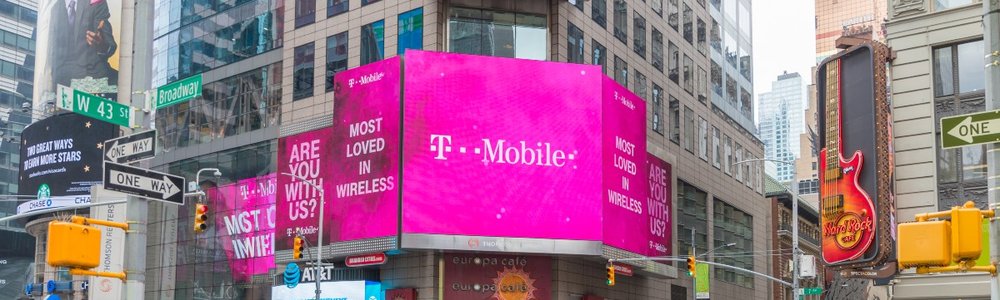
T-Mobile US reported solid fourth-quarter and full-year 2022 results that included continued growth of its 5G-focused fixed-wireless access (FWA) product, but the carrier provided little update on its most recent cyberattack that impacted 37 million customers.
Backed by the usual animation from company executives, T-Mobile US reported solid operating results that were undercut by the operator having already pre-announced high-level numbers in early January. There was a lot of emphasis placed on customer growth meeting expectations and a slight bump in average revenue per user boosting Q4 service revenues 4% year over year.
Some of that growth came from T-Mobile US’ fixed-wireless access (FWA) high-speed internet service that gained two million new connections in 2022, pushing its total FWA customer base to 2.6 million customers. CEO Mike Sievert said that growth was more than rivals AT&T, Verizon, and cable operators Comcast and Charter managed to add combined over the same time period.
Sievert said the carrier’s approach to FWA is solely focused on expanding the reach and capacity of its 5G mobile network, which differs from its rivals' approaches. Those other approaches include an ongoing focus in expanding fiber-based broadband access in the case of AT&T and Verizon, and the cable providers staying focused on growing their cable-based broadband business.
“We're on a mission to become the best in the world at wireless, and we're pursuing that mission ambitiously, and so far, very successfully,” Sievert said. “That is the place where the future lies and where we want to be.”
Sievert did acknowledge that a fiber-based broadband connection should be faster and have more capacity than a spectrum-constrained mobile connection, however, T-Mobile US’ mobile path is simpler to deploy.
“It's kind of like the people at Ferrari pointing a finger at the world's best-selling car, Toyota, saying, ‘we're faster. We have the faster car.’ Yes, but Toyota is the world's best-selling car and that's because – and if you look in the case of T-Mobile 5G home broadband – it's perfectly suited to what people want,” Sievert explained.
T-Mobile US plans to grow its deep mid-band 5G spectrum coverage from 265 million potential customers at the beginning of this year, to 300 million potential customers by year-end. It’s also deepening that spectrum pool by re-farming its 1.9 GHz spectrum resources that had been powering its 3G networks.
'Disappointed' by latest cyberattack
Sievert also looked at the glass as being half full regarding the carrier’s most recent cyberattack. He stated that the investments the carrier made last year to bolster its cybersecurity capabilities reduced the blast radius of the attack’s damage.
“While I am disappointed that the criminal actor was able to obtain any customer information, we are confident that our aggressive cybersecurity plan, working with the support of some of the world's experts, will allow us to achieve our goal of becoming second-to-none in this area,” Sievert stated.
That investment was actually part of a class-action settlement, which included a $150 million commitment for cybersecurity updates that were also tied to $350 million it agreed to pay in compensation to customers from a previous cyberattack.
Sievert’s comments appeared to be enough for financial investors and a few of T-Mobile US’ Twitter followers as the carrier was not questioned any further on the attack. A request for comment from SDxCentral following the earnings call was directed toward the carrier’s previous statement.
The carrier reported the most recent hack on January 20, stating that its systems were breached around November 25, and that the attack was not discovered until January 5.
During those six weeks, the attackers had access to customer information that included names, billing addresses, emails, phone numbers, dates of birth, account numbers, and information such as the number of lines on an account and service plan features. The carrier confidently stated, “no passwords, payment card information, social security numbers, government ID numbers, or other financial account information were compromised.”
It also tried to downplay the information accessed by stating it was only “basic customer information … nearly all of which is the type widely available in marketing databases or directories.”
That attack also reportedly impacted Google’s Fi service, which is one of T-Mobile US’ most prominent mobile virtual network operator (MVNO) partners.
Comments