

Georgetown University recently signed a multi-year deal with Cisco to upgrade the university’s sprawling campus network, a process that Georgetown CIO Doug Little described as becoming increasingly necessary for similar institutions and one that can be more easily conquered if planned correctly.
The agreement itself includes the deployment of Wi-Fi 7 technology across Georgetown’s classrooms, dorms, stadiums, and common areas, providing the university with access to Cisco’s latest networking gear. This includes the ability for Wi-Fi 7 to access a broader swath of untapped spectrum resources in the 6 GHz band to support higher throughput and capacity.
The deployment also includes supporting infrastructure like servers, racks, and wired connections, some of which are being deployed as part of a broader cleanup of physical and virtual environments.
Little explained that this additional performance is needed and both technology and device proliferation has “exploded.”
“Folks are not just bringing one device, they're bringing multiple devices to campus, so what we really want to do is have a network and the backbone of what we do here that is very much future-proof and can handle what our students are coming to campus with, and we want them to have that same seamless experience on our campus as they do at their home,” Little said.
Technology planning
That future-proofing did require substantial planning, as Little noted the deployment itself will be a “six-year project in total,” which from a technology perspective is a lifetime. As such, Little extolled the benefit of working with a tech-savvy vendor to help with the process.
“We have our own engineering team, so we're going to be able to run it ourselves,” Little said of the network. “But … it's not just sort of this project, and then Cisco goes away and waits for the next big project. They're with us side-by-side … their engineering team and their roadmap team keeps us up to date about cutting-edge advancements in the product, also then what's coming next, so that we can be sure that there's no gap or space between what we're doing as best practices, what they think should be best practices, and then what next advancements they're making.”
This specific process is helped by Georgetown’s long-standing work with Cisco, which means that a lot of the equipment being replaced is legacy Cisco gear. However, there are other unnamed components also being exchanged as part of the overhaul.
Gary DePreta, SVP of U.S. public sector at Cisco, noted that this is an increasingly common environment for the vendor.
“The environments that Doug described … they're much different requirements, but you can plug those bespoke use cases into the network, and if you think about it, what Doug wants to do is not only deploy it, but over that six-plus year – not a deployment schedule, but lifecycle – you want to make things like provisioning very quick," DePreta said. "If you have that solid platform, you can make it so it's flexible to the needs of the use case.”
While the technology is deemed “solid” the same can’t be said for Georgetown’s physical environment, which brought along its own challenges.
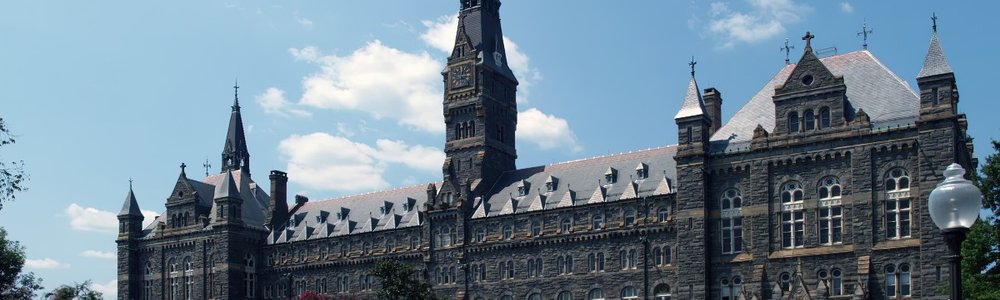
“We're doing some water remediation on our on our main quad, and so they were putting some drainage and ran into coal chutes that used to feed the buildings,” Little said of that environment. “When you've been around since 1789, there's lots of stuff buried in and around. We have to be very careful and respectful of historic buildings, but also still provide the services that we need to power our education.”
This work also allowed Georgetown to tackle long-standing deployment patch jobs that many other tenured institutions might find familiar. This includes a lot of “closet remediation” and “cable replacement.”
“As we're going through some spaces, we found some equipment sitting on milk crates and other things that are definitely not best practices, and I think every institution has that,” Little said. “I think what's important in major projects like this with huge investments is, measure twice, cut once. Before we get all that equipment in, before we start installing, just be crystal clear. Is our cabling ready? Are our closets ready? Does this equipment have that safe-and-sound home? Are we ready to put it in? That's really what this last year has been focused on is making sure that when we get that precious equipment that’s the lifeblood of our campus in, it's going to be going in the right place, connect to the right cables, have the right cooling, and really be ready to rock and roll from there.”
What is Georgetown learning?
Like students themselves, Little said he has learned a number of things through the process, with one of the most important being to have a good plan in place before proceeding.
Little explained that it’s important for others in this position to have a clear vision of what they are trying to accomplish, especially from an investment perspective as finance teams will want details on a clear return on investment (ROI). Georgetown’s ROI position was helped by the sprawling network need.
“For us, we are an undergraduate sort of instruction, teaching, and learning first institution,” Little said, adding that Georgetown also holds the Carnegie Classification of Institutions of Higher Education’s designation as an “R1” institution tied to its high level of research activity, has a medical center, and a law center.
“But the common thread between all of them is that deep interaction and deep learning,” Little continued. “And so, when our faculty innovate in the classroom, they bring more devices. They bring more things in, like simulation, like AI, like holographic images. When they start to bring that into the classroom, we can't have them waiting on us to catch up. And so that was what our big ROI was.”
Little also noted that the upgrade process is allowing Georgetown to simplify its networking stack from a physical and virtual nature, which is another long-term ROI driver.
“We had a whole team of folks that was running telephone wires,” Little said of its previous technology stack. “We're now on Zoom phone and so we now run that on the network.”
This means that the telephone systems is now “even more valuable and more critical than it was before.”
“So now, if there's an emergency, the network is on, the phones still work, so the network can't go down. The phones always have to work, particularly in our current environment, in higher education,” Little said. “So those were the ROIs that I really sort of kind of hit on. That health and safety ROI, the research ROI, and overriding we have to be ready for whatever the future of teaching is.”

Comments