

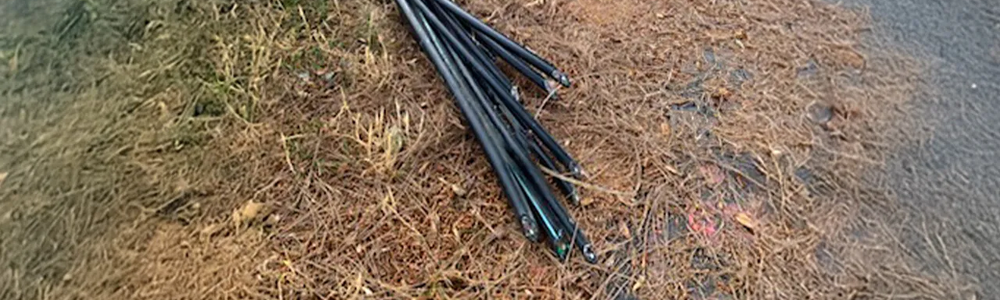
T-Mobile US has invested billions-of-dollars to take advantage of and support a dramatic surge in network data traffic, however high-profile service interruption incidents caused by fiber cuts, vandalism, and theft have shown an increased focus on network resiliency as being key to maintaining connectivity and are issues that deeply impact carrier infrastructure executives.
Lori Aimes, SVP of infrastructure and operations at T-Mobile US, explained to SDxCentral that the carrier’s biggest source of network “downtime” is “transport downtime driven by fiber cuts.” These types of incidents have played out in very public ways across the industry.
“Part of fiber cuts is theft and vandalism, which is on the rise,” Aimes said, adding that “our downtime driven by those factors is probably up in the 30% this year … so it’s a massive problem.”
Aimes noted that this is a growing issue across the industry that “breaks my heart, … this kills me.”

That notion was highlighted by AT&T earlier this year when it reported it was the victim of more than 10,000 “copper theft incidents” in 2025, hits that were cumulatively valued to the tune of $82 million.
Rahdeese Alcutt, lead investigator for AT&T Global Security, noted in a blog post that the carrier experienced a weekly average of 200 “incidents reported nationwide at the end of 2025.” A vast majority of those happened in California, where “we experienced more than 7,300 copper theft incidents in 2025, with losses exceeding $54 million.”
“When copper theft occurs, it affects connectivity, transportation, lighting, and service availability,” Alcutt wrote. “When these systems are hit, it’s not just ‘network reliability’ at stake. It’s a commute that breaks down and a neighborhood left in the dark.”
Aimes explained that T-Mobile US has implemented a number of initiatives to thwart such incidents, including increased interactions with construction crews that might be working in the area of telecom infrastructure. The carrier is also trying to better protect deployed infrastructure, especially metal components like copper that have a high street value.
“We're closing manhole covers. We're putting signage everywhere we can to say there is no copper here. Even on the fiber, it says this is not copper you ding dongs,” Aimes said.
T-Mobile US is also working with metal wholesalers where vandals typically look to cash-in their loot.
"All of these thieves have to unload their copper to somebody, so if we go there and stop it there, that's been effective," Aimes said of these efforts, which include offering those wholesalers more money to not accept stolen goods. "[The criminals are] getting organized. They're rings, and what's been happening is this ring of organized crime essentially will roll into a market and just like ants, just start attacking all over the place."
T-Mobile US is also part of the Strategic Threat Response & Infrastructure Knowledge Exchange (STRIKE) that was formed last year. That group is co-led by CableLabs subsidiary SCTE and the Internet & Television Association (NCTA) and is focused on tackling the unprecedented wave of criminal attacks on critical infrastructure.
“We're all trying to solve the same problem of this scourge in our industry because it's killing us all and it's killing all of our customers,” Aimes said.
Resiliency matters
Depsite those efforts, downtime is inevitable. As such, Aimes said a key part of her team’s focus is in adding resiliency to the network transport architecture. This includes multiple transport paths that can take over in the event of a main transport failure.
“Where once we would have never dreamed of having more than one backhaul solution at a cell site, now I've got a team whose whole mission is to figure out cost-effective ways to get additional resilient solutions,” Aimes said. “Just like you bring generators or lithium-ion batteries to cell sites for power, which we are doing that as well, I'm trying to figure out: I've got fiber as my primary circuit, microwave as backup, free space optics lasers as potential backup, sometimes satellite as backup.”
Aimes is also looking at using “untrusted backhaul, like a regular internet site that I might buy from Comcast.”
“That would work primarily in rooftop-type of configurations, not at a cell site,” Aimes explained, noting that it would also have to tackle security concerns with such a model. “We [would] have to wrap it in some IPsec, but there’s not a single rock we're not turning over to try to figure out how to solve this problem.”



Comments