

Esports. Competitive video game competitions. For many, the idea of organized events involving professional gamers arose in the 2000s through the meteoric rise of online multiplayer, and the formation of organizations like Major League Gaming (MLG) and, a little later, FaZe and Clan.
Esports can trace its roots as far back as the early 1970s, with competitions at universities like Stanford, which hosted Spacewar! for the PDP-1 minicomputer. In the late 70s and early 80s, there were arcade video game competitions all over the world, culminating in WTBS’ Starcade show. And 1988 saw the release of one of the first online games in Netrek, a Star Trek-themed multiplayer battle simulation title for Windows and Mac.
But in the world of today, esports are as culturally ubiquitous as sports like cricket, basketball, or even soccer, with global fanbases and multimillion-dollar prize pools.
The main differentiator for esports compared to its contemporaries is how it's consumed. While broadcasters like ESPN or Sky Sports will showcase the odd event – like the Valve Major Championships or the FIFAe World Cup – the vast majority of esports get their fix via streaming.
Take the PGL Major 2021 in Stockholm, one of the biggest events in the Counter-Strike: Global Offensive (CS:GO) calendar. Some 2.7 million viewers tuned in to watch the event. And while that was at a time when most of the world was locked indoors, fast forward to the 2024 League of Legends World Championship. Around 6.9 million people tuned in to watch, with the vast majority tuning in via streams on sites like YouTube, Twitch, and CHZZK.
So while the audience and their means of consumption have matured, the technology underlying the events themselves is lagging, and event organizers want that to change.
Veloce, which started life as a motorsport talent agency before transitioning into managing simulation racers, is among those demanding improved connectivity means to bring their esports events to life.
The firm teamed up with the GSMA’s Fusion initiative to urge mobile network operators to accelerate programmable 5G network deployments to better support esports event organizers
“Esports have traditionally relied on dedicated infrastructure to guarantee performance,” explained Cam Royal, head of esports and gaming at Veloce Media Group. “We have now seen first-hand that modern 5G networks can deliver the same competitive conditions on mobile. The next step is to enable that capability at scale through standardized APIs, which will unlock entirely new formats for mobile tournaments, live fan experiences, and creator-led content production.”
Full throttle APIs
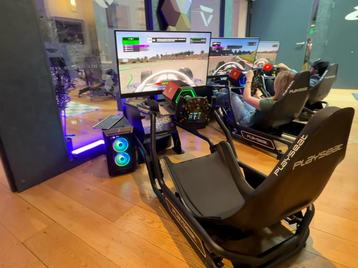
At a press event at its headquarters in London, Veloce debuted a "Statement of Requirements," which along with GSMA Fusion claims that mobile esports and large-scale live content need to protect simulators from congestion and unlock new revenue streams.
Veloce essentially wants access to 5G standalone (SA) to bolster connections at its events, where multiple racers compete across tracks using high-end simulator rigs.
Instead of using a single LAN with all the systems connected on the same network, the desire for 5G SA would allow for its sim racing events to make use of more advanced features like slicing. This could allow each simulator to run on its own individual slice to avoid network congestion from broadcasters or fans taking up bandwidth.
Another key demand was exposure to quality on demand (QoD) and related Camara-standard network APIs, which it argues would allow it to unlock new types of venues and formats, such as race events in fan zones during actual F1 race weeks or major arenas. Veloce argues that pairing low-latency connectivity with standardized QoD APIs would enable it to support racers and an entire ecosystem of streamers, creators, and production teams pushing out real-time coverage from the heart of the action.
The Veloce team has already had a taste of how the technology could augment a racing simulation event, having demonstrated four simulators using a 5G SA network from Ooredoo Qatar at last year’s Mobile World Congress (MWC) event in Doha. Those tests showed seven milliseconds of end-to-end latency and 1 Gb/s download speeds, which meant races could run at near real-time with virtually no ping.
Royal described connectivity from those tests as “impeccable,” adding, “it was arguably better than our HQ, so for us to be able to leverage that and take that to more remote locations creates a lot of opportunity.”
Veloce and its partners argue that 5G SA is about more than raw speed. They see value in the added network intelligence and programmability that comes with QoD APIs, such as granular visibility into available capacity, the ability to request specific latency and throughput profiles ahead of a race, and the flexibility to spin up “pop-up” high-performance networks for a single weekend and then pack them away again.
“The API integration is really important, just because we get that assurance that we're going to get the correct quality we need to keep streams going [and] being able to analyze in real time the network intelligence in case we need to pump more into certain areas of the production or the actual PCs that the gamers are on as well,” Royal added.
Veloce argues the same network infrastructure can unlock something equally valuable for its broader business: live, on-location content from its creator roster.
IRL (in-real-life) streaming – where creators broadcast directly from public venues, events, and remote locations – places heavy demands on mobile uplink, and is acutely vulnerable to the kind of congestion that 5G SA with QoD APIs is designed to solve. Veloce points to Aarava, a founding member of its Quadrant team and one of the world's largest racing gaming content creators, as an example of a talent already expanding into IRL formats through streams at events like F1 car launches.
With guaranteed uplink performance and the ability to request priority bandwidth on demand, the organization argues IRL creators could activate audience-led concepts from virtually anywhere, like paddocks, fan zones, or entire stadiums, without the stream quality being at the mercy of everyone else on the same network.
There’s also a resilience dimension. High-profile virtual endurance races have been marred by distributed denial-of-service (DDoS) attacks and unstable connections, such as the CrowdStrike outages, which impacted iRacing in 2024, or, more seriously, the security breaches during the 2023 virtual Le Mans race that saw server IP addresses inadvertently made public. Veloce believes dedicated, operator-managed 5G SA setups, potentially including portable, event-specific units, could offer organizers and teams a more controlled, harder-to-disrupt environment than relying solely on consumer-grade broadband and public gaming servers.
Big rigs, bigger picture
For Veloce, ambition ultimately extends beyond a cleaner connection for a handful of simulator rigs.
Portable, operator-managed, programmable 5G networks that can be stood up, tuned, and packed away over a single weekend – the infrastructure case they're making – is one that it believes could reshape how live competitive gaming is staged.
By untethering it from fixed venues and dedicated LANs it has historically depended on, it could open up opportunities it views in what it considers “priority markets,” including the U.S., Brazil, and Saudi Arabia.
Whether mobile operators move quickly enough to meet that ambition is another question. But the Doha demo at least gave them a proof of concept (PoC).





Comments