


The first iteration of the revamped FIFA Club World Cup came to a close over the weekend, with Enzo Maresca’s Chelsea defeating European champions Paris St-Germain in New Jersey.
What was once an annual competition involving the champions from six continental cups is now a quadrennial 32-team competition. With a prize pot encompassing a whopping $1 billion, FIFA wants the new look tournament to eventually be as popular – and lucrative – as the International iteration.
Despite a rocky reception from largely European skeptics, half-filled stadiums in the group stages, and severe heat, FIFA President Gianni Infantino heralded the event as “an incredible success.”
Behind the scenes, the tournament was a test of modern IP-based broadcast infrastructure, showcasing how high-profile sports events can be broadcast across a hybrid cloud-fiber-IP network at scale.
The rights to the content that TV viewers watched went to streaming platform DAZN, which only secured those rights in February, mere months before the tournament kicked off. For comparison, the rights to the 2030 World Cup were sold in December 2024.
You might think that such last-minute rights deals would impact broadcast quality, but despite the compressed timeline and global scale of delivering 63 matches across multiple continents, DAZN managed to pull off that task thanks to its long-time partner Encompass Digital Media Broadcast.
SDxCentral spoke with Keir Shepherd, chief solutions officer at Encompass, to learn how they supported DAZN in delivering the tournament across linear broadcast and over-the-top (OTT) platforms for football fans worldwide.
Behind the broadcast stack
Encompass has worked with DAZN for the past several years, supporting the streaming platform with other sports like baseball and golf. Shepherd said the company was well-positioned to support DAZN, given that the firm handles around 250,000 hours of live events globally each year.
The pair have some history on last-minute projects, with Encompass having previously worked with DAZN after the streaming service picked up some rights for events at the 2024 Olympics in Paris.
While Shepherd acknowledged that DAZN tends to have its rights in place well in advance of prior projects, he outlined that many of the events Encompass works on end up being late-notice or occasional-use events, such as when they supported a ballet performance just a few days before the broadcast.
To bring to life FIFA’s new vision for the Club World Cup, Encompass helped DAZN set up three studios supporting English and Spanish language feeds for the U.S. and international markets via its facility in Stamford, Connecticut (aptly named given that Stamford Bridge is the home of tournament winners, Chelsea).

For the Club World Cup, Encompass’s support was a multifaceted undertaking: spanning live production, multiplatform distribution, and real-time management. This included signal acquisition and IP distribution across multiple regions, implementing graphics during dynamic ad breaks, and 24/7 monitoring from its London media center.
To power the network behind the Club World Cup streams, Encompass’s facilities are interconnected with its own fiber network, backed up with an internet-based IP network. Encompass provisioned dual-fiber circuits for each of the three core video signals, with a tertiary IP fallback. This triple-path redundancy ensured that even if a fiber line failed, DAZN’s live broadcast wouldn’t miss a beat.
That reliability was crucial given the global scale of the event and the fact that DAZN’s broadcast operations were stood up in just months. Despite the short lead time, Shepherd suggests delivering live support is “actually more reliable than point-to-point connectivity.”
“Point-to-point fiber is point-to-point. So anything that goes wrong between those points, you lose a circuit,” Shepherd explained. “The internet's been built to work around faults, so if you lose a router or a peering point, it will work around it to layer over the top of that, and you get really high reliability.
“We’ve been doing this with a lot of our sports customers who are doing high-profile events,” he added, noting that Encompass recently supported the LIV Golf tournament.
OTT and affiliate distribution complexity
Alongside managing the live production side of the tournament, Encompass helped DAZN spin up three dedicated 24/7 channels – one for the U.S. market and two for international audiences, in both English and Spanish.
Encompass also dynamically inserted graphics and ad elements during breaks, adapting to changes like extra time or penalties.
“We were doing dynamic graphics, so things like double boxes for breaks, for getting commercials in there, but building dynamic ad breaks as well,” Shepherd explained. “Creating, building those ad breaks and making sure we can help fill those ad breaks.”
The company also handled ad insertion and replacement for OTT viewers, inserting messages to signal downstream ad systems. “Each of those ad breaks, we were replacing the adverts, but also ensuring we’re inserting appropriate messages,” he said.
The live signals were fed into Encompass’s Altitude Media Cloud, where additional services like digital-rights management (DRM), OTT packaging, and content delivery network (CDN) distribution were deployed.
“Exactly the same stack that we’ve been historically running for DAZN for their 24/7 OTT services – we spun up three additional services,” Shepherd said. “This was in our Frankfurt and London cloud regions.”
DAZN targeted up to one million concurrent viewers, requiring cloud-based scalability across multiple CDNs.
“We had three parallel CDNs that they were looking for support,” he added. “If they want to add a new CDN ... they can just add that, and they can make a fourth, make a fifth.”
Beyond OTT, Encompass also supported affiliate distribution globally, including takers in Europe and as far away as Australia.
Monitoring for both OTT and affiliate output was centralized from Encompass’s London media center, with fault detection handled by the same team that manages DAZN’s services year-round.
“That same team that was monitoring the DAZN OTT output was also monitoring the distribution output using the same set of tools with the same control interfaces,” Shepherd said. “So any faults were tracked, detected, and resolved by that same team.”
World Cup on the horizon
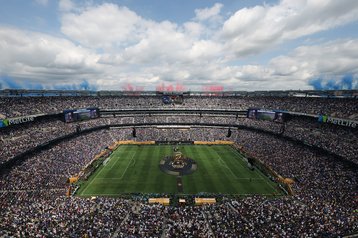
Traditionally, the Club World Cup has acted as a testbed for the World Cup, and despite the revamp, the 2025 iteration was no different.
The 2026 iteration of the World Cup will take place in the U.S., Canada, and Mexico. On the pitch, issues with heat and scheduling kick-offs will likely be top of the agenda for FIFA.
Off it, though, for the team at Encompass, Shepherd told SDxCentral the thing to work on would be graphics, specifically the flexibility required for overlaying information, especially those that drive ad sales.
The World Cup is one of the most lucrative sporting events in the world, with the 2022 edition in Qatar generating $7.5 billion in revenue, more than $1 billion more than Russia 2018, driven by new sponsors like Crypto.com and blockchain firm Algorand.
Shepherd explained that while ad-driven graphics were present at the Club World Cup, a lot of that work was done manually, adding: “It relied on our operators to build the events ahead of the game and manually trigger during the game.”
“One of the key takeaways is we can build automation into the schedules, so when we know what the event is and how many breaks there are, we can dynamically create the graphics and have them queued up," Shepherd added.
Such a concept would likely be needed for the 2026 World Cup, given dynamic weather expectations. During Chelsea’s 4-1 win over Benfica, the game was delayed for two hours, mere minutes from full time, due to a lightning strike in the area.
It’s even an area where AI could come, with Shepherd suggesting the technology could help the broadcast teams determine where cuts occur and when to trigger ad breaks.
The technology was already employed by Shepherd and his team during the Club World Cup to generate captions, in partnership with AI Media. The captions were automatically generated during games and integrated into their feeds.
“We're pushing a little bit more into the translation space, and for something like the World Cup that would become really important, being able to make the content as widely available as possible," Shepherd said.
More to come?
Whether you had a passing interest in the tournament or not, given FIFA’s labelling of the tournament a success, the Club World Cup looks set to stay. The Guardian reported Qatar has already inquired about hosting the next iteration in 2029, which would require the tournament to move to the winter.
For Shepherd and the team at Encompass, the Club World Cup was a month-long showcase of how to bring a premier sporting event to all corners of the globe.
But the tournament also showcased new content streams that he said will eventually filter their way through the various football leagues, such as point of view from the match official, or Ref Cam.
“It's all driving more data for the events,” Shepherd said. “Football has been a little bit behind some of the other sports, especially in North America, where they've been driving multiple data, video, and audio feeds as well, and then being able to have more personalized feeds if you have a particular preference of the way you want to watch a match. What we're doing is enabling more data to flow through, more video, more audio to flow through.”





Comments