


When it comes to hosts for the Winter Olympics, you’d be forgiven for thinking Milano Cortina was an unorthodox place to hold the games. Instead of the traditional single-city host model, the 2026 iteration opted for a highly unconventional sprawling layout snaking across Northern Italy.
Logistically speaking, it sounds like a nightmare: Freestyle skiing can be found in Livigno, biathlon events take place in Antholz, and Cortina d’Ampezzo is home to luge and curling. Even the closing ceremony will take place in Verona, some 90 miles away from where the opening ceremony was held in Milan.
In total, there are more than 40 sites, some 15 venues, all of which are spread across three total regions spanning more than 8,550 square miles (22,000 sq km). With such a dispersed affair, then, the International Olympic Committee and the event organizers must bring on board partners capable of delivering at such scale.
Juniper Networks was the vendor chosen to supply networking equipment for the games, but a $14 billion acquisition from Hewlett Packard Enterprise (HPE) saw a converged effort on connectivity for the 25th edition of the Winter Olympics.
Stefano Andreucci, HPE's senior sales director for south Europe, described the final deployment as “the most advanced network we ever built for the games.”
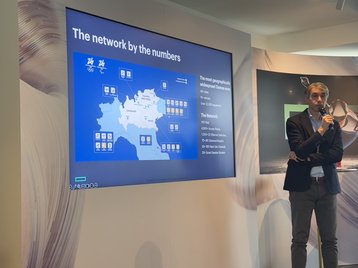
In terms of numbers, the monumental effort encompassed more than 4,900 access points, some 1,500 Ethernet-based EX series internet switches, more than 70 MX Universal routing platforms; more than 50 SRX firewalls, and more than 30 Smart Session routers.
Not only is reading through that extensive list of product lines tedious, but the on-site engineers faced the immense challenge of actually implementing them to support the event's unprecedented geographical spread – where even the varying weather conditions from site to site could hamper efforts.
The team behind the network then needs to be at the very top of their game, just as much as the competing athletes.
Andreucci compared their efforts to the role of a waiter, explaining, “The job of the waiter is to deliver a great experience. It's the same for the networks. We are here to deliver a great experience. We don't want only to move data from A to B, we want to deliver a great experience to the athletes, to the spectators, to the media, to the officials, and also to the volunteers.”
AI takes to the slopes
If Milan Cortina is the antithesis of Winter Olympic planning, then HPE’s use of AI in its network for the games was the living embodiment of today’s AI-first reality.
AI infusions in the Olympic network continue the tech giant’s mission to build what it routinely describes as “self-driving networks.” In the words of Juniper CEO-turned-HPE exec Rami Rahim, that’s a network that can self‑configure, self‑optimize, and self‑heal to drive trouble tickets to “practically zero.”
The augmented network continuously ingests tons of data points, minute by minute, from sites across the three regions, helping to handle changes in traffic loads, such as when an event pauses and everyone goes on their phones or changes in the weather, all without manual tuning.
The self-driving concept extends beyond just autonomous monitoring to areas essential for Olympic events: performance clocks, timing systems, and measurement equipment, all of which are connected to the network.
As Rahim explained, unlike human users who can voice complaints, such as saying “the Wi-Fi sucks,” a device like a precision timing gate simply can't. This lack of feedback ability for non-human endpoints makes networks designed to measure whether the person or “that thing” is satisfied with the network essential.
Supporting that array of network monitoring during the games is Marvis, an AI-augmented assistant tool. Think of it as an engine behind HPE’s Mist platform; it powers AIOps capabilities that let engineers troubleshoot using natural language.
Staff supporting the games can, for example, ask Marvis what the network user experience is like in the skating arena, and the system provides a detailed view from that particular venue.
“[Marvis] is useful because you reduce the amount of work,” Andreucci said. “We have such an extended region, you can’t have a single person running each site. It’s a kind of HPE ChatGPT. It helps you to understand and prevent issues and know exactly what's going on in the network.”
It's supported by an experience model developed using real-world deployment data accrued over the past decade, with an underlying large language model providing the conversational capabilities.
When probed by SDxCentral about the large language model (LLM) component, Rahim said the conversational component was “really only a part of the solution,” adding: “The LLM capabilities are more about the interfacing with our customers, with specs, data, about product usage, just making it easy to have a conversational interface. It's not the whole solution. In fact, it's a really small part of the solution.”
Marvis will operate across all of HPE Networking’s technologies, not just Mist. Rahim outlined its importance beyond the games, saying: “For the last decade, we have been learning from real deployments with the largest health care, largest retailers, largest schools, etc., and this has given us real institutional knowledge about what it takes to deliver exceptional experiences in these types of deployments. All of those earnings are essentially applied to Milan Cortina.”
James Robertson, HPE’s field CTO for networking, examined the Marvis advantage from another angle, one less about AI capabilities and more about what that decade of deployment data means in practice for the people using it.
Engineers at the games, some of them at different stages in their careers, effectively had 10 years of institutional knowledge accessible through a conversational interface.
“Having that historical data, whatever happens on the infrastructure, the data is already, to some extent, historically known to a situation, ‘Oh, I've seen that before, this is what I need to do. This is the solution I need to provide. This is how I fix it.’ To me, that is of critical importance for small teams," Robertson said.
Olympic-level backbone and security
If thousands of access points and switches represent the surface layer of HPE’s Juniper-infused Olympic network, the backbone is what holds the whole thing together underneath.
The architecture HPE settled on centred on the Juniper MX Universal Routing Platform, the same class of hardware that has been underpinning major internet backbones for decades.
Rather than a single central hub, the design relies on two core labs, one in Milan and one in Verona, with MX routers deployed at each of the venues across the three regions. Traffic from those venues aggregates into the back end of those hubs; the front end handles onward connectivity out to cloud providers and the wider internet.
It's worth noting what HPE isn't responsible for: the fiber connecting those sites was the domain of other partners. But every router riding on top of that infrastructure was doing the work of interconnecting the 40-plus sites across the games.
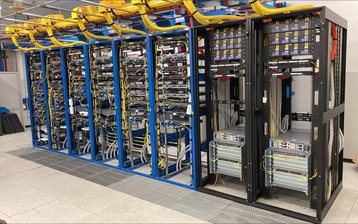
“The difficulties was not only to deliver the backbone, because once you deliver the routers, then it's easy, but also the different devices,” Andreucci said, highlighting that some devices needed to be rugged enough to handle cold and snow.
“The key factor was having a central platform like HPE Mist where you can see, for example, that the fiber is not working in the city. Fiber is not working in the other part of the region. It's also really key to having the technology that allows you to control the three different regions,” he added.
What made that possible, according to Robertson, was approaching the deployment as genuinely end-to-end, from the edge point where a spectator's phone connects, all the way through the WAN to whatever resource they're trying to reach.
But with thousands of connected devices, it makes the games an obvious target for bad actors. HPE team's approach to security wasn't to ring-fence the network with layers of reactive tooling, but to make security structural.
“A firewall is not security,” Andreucci said. “Security is in every network layer, and from zero trust, access control to AI-powered threat detection and mitigation. The network continuously protects sensitive athlete data, media feeds, and logistic information security, and was a key feature for Milano Cortina.”
Robertson described it as a defense-in-depth strategy, with offerings like the SRX firewall series forming a layer in the stack, upon multiple layers of defense supported by policy-based zero-trust controls forming another.
“Moment by moment, day in and day out, the infrastructure is protecting every single venue in real time. As those things pop up, we're knocking them down,” he added.

HPE’s Rami Rahim: Olympic network proof of ‘seamless’ Juniper integration
Juniper CEO-turned-HPE exec says AI-infused deployment in Milano Cortina shows growing strategic importance of networking
Complementary convergence
In a way, the combined HPE Networking acted as an early example of the two portfolios coming together.
Rahim was keen to emphasize this to the gathered press in Milan, saying it served as “the solid foundation of any digital transformation project.”
Responding to a question from SDxCentral on when HPE came into the picture to support the previously Juniper-only deployment, Rahim revealed planning started prior to closure last June, adding: “There were a number of efforts, customer engagements, [and] projects that had started prior to close.”
“Our No. 1 priority as we went through the closure process, No. 1 was do no harm; no customer shall feel any disruption whatsoever,” Rahim said. “Of course, we want to maintain the innovation engine. We want to maintain projects that are in flight. We want to then go and build this incredible, compelling joint roadmap. We've done all that. But I'm sure the Milan Cortina organizers will tell you, it has been a seamless process for them.”
He went one step further, suggesting the Italian games will “set a new precedent for how platforms for future events will be built and operated.”
“It goes back down to the fact that you cannot just rely on humans to deliver an exceptional experience,” Rahim expanded. “Humans cannot scale, measure on a per-second basis, whether everybody connected to the network is actually happy [and] experiencing something that's very positive.
“We are going to set an example for all future events by leveraging artificial intelligence to deliver that exceptional experience in real time to all stakeholders.”
No router gets left behind
When the curtain closes on Milano Cortina at the end of February in Verona, and the games will gear up to cross the French Alps in 2030, what happens to the thousands of access points, switches, and routers once the curtain closes?
Robertson said it has to embrace the IOC’s minimal disruptive footprint in terms of greatly reducing waste, with a Juniper-certified partner set to take back much of the equipment to be dismantled and refurbished.
So while the newly converged team at HPE helped bring connectivity to the thousands of athletes and officials throughout the games, the devices that helped make it happen will gain a new lease of life to continue that legacy elsewhere.







Comments