

The Buffalo Bills are set to start their new season with high performance hopes that will depend on a host of variables, but one area that’s basically guaranteed to show an improvement over previous seasons is the Wi-Fi performance at its new home stadium.
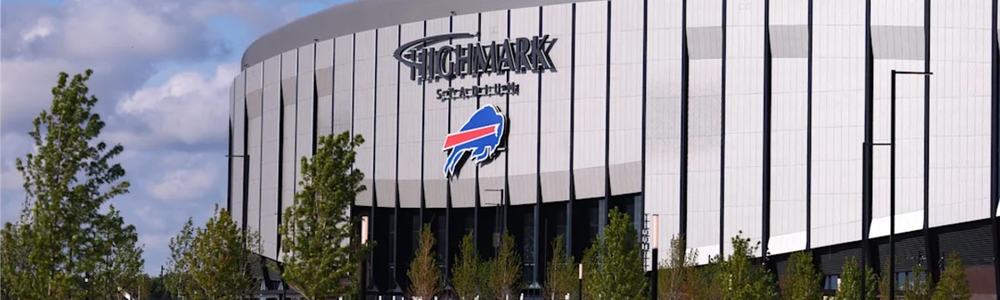
That new stadium is the 60,000-seat Highmark Stadium, located in the Buffalo suburb of Orchard Park, New York. Constructed at a cost of around $1.7 billion, the facility includes a partial roof that should please some fans come early January, but more importantly a more robust wireless network to handle what will hopefully be a stadium full of fans cheering on the team during a playoff game.
That network is under the guidance of Shaun Handley, the Buffalo Bills’ IT infrastructure project director, and 22-year veteran of the team. And what Handley is guiding is a completely new Wi-Fi network that taps the latest Wi-Fi technology and gear from vendors like Cisco and Nutanix, gear that the tech lead said is becoming increasingly important to fans.
Handley explained that one of the “major pain points” at the old stadium “unfortunately, was the Wi-Fi system that we had in place.”

“It's just one of those situations where it got old and died,” Handley said, before adding, “I won't say ‘died over time,’ but it just got slow over time. … If you went into the old Highmark Stadium for a game, connectivity was pretty much non-existent. You walked in there, you tried to make a call, you tried to send a text message, you tried to send out anything at all, whatever you were on, it was not working. It was really really bad.”
That network was based on legacy Wi-Fi technology and an outdated deployment model that could not keep up with soaring demand.
The new system relies on equipment from Cisco, including Wi-Fi access points and telemetry feeding into a single Catalyst Center management console. Handley said this myopic approach was key for his “very lean team.”
“Nothing against people that have a multivendor environment, but for me, it's nice to have a single pane of glass and just be able to manage everything efficiently under one,” Handley said.
The new stadium is one of the first in the league using Wi-Fi 7 technology, which opens up significantly more bandwidth capacity. Handley noted that during one of the pre-season games the new network showed a more than 800% increase in network speeds and capacity compared to the old stadium and network.
“When you're with Wi-Fi 6, you're limited to the channels that you have and the frequencies that you have. With Wi-Fi 7, it opens those up,” Handley said. “When you're in a stadium, especially an NFL stadium, the interference in frequencies and it just keeps getting worse and worse, they start to just clog that whole entire building up. But now with Wi-Fi 7 you have much more ability so you don't have that interference that's treading on everything, treading on all your fans, and you're not running into so many problems with either your fans or with whatever else is out there. So that's a big deal.”
That deployment also puts the stadium at the forefront of the latest broadly available Wi-Fi standard, something that should pay off in the near term.
“You don't want to be the first person out there to try something, especially in a building of 60,000 people, and then next thing you know, it's failing, and you're just, ‘what do I do?’” Handley said. “You want to buy something that's tested true and ready to work in an environment.”
Non-traditional deployment model
Handley also noted the deployment focused on installing the access points and equipment off of the ground when possible, something important for an outdoor stadium in Buffalo. This includes antennas installed in the stadium canopy to cover wide swaths of the seating areas.
“Here with our winters, you worry about the snow shovels hitting them,” Handley said as compared with equipment at some stadiums that is placed under seats. “When you're putting all of these under seats, now you're core drilling into your stadium, and eliminating having to do all these under seats when you're able to get everything up to a canopy antenna is huge. It's a major cost savings.”
Another unique feature is that the network is supported by a “technology building” that houses the backbone infrastructure. This includes Cisco’s Firepower 2110 data center rack equipment, the network infrastructure core, the stadium’s distributed antenna system (DAS) infrastructure, the truck interconnects, and what Handley termed a “massive amounts of fiber that are connecting” that building to the stadium.
The technology building also relies on software from Nutanix, which was a move away from the team’s previous work with VMware. Handley said Cisco helped with that selection, adding that “it just worked out much better for us and the infrastructure that we just put in place, especially for looking to upgrade in the future and what we need to do, it just proved to be the best move for us.”
This purpose-built facility was touted as providing for easier maintenance and servicing; improved physical protection and resiliency; a centralized technology operations center for easier management; and preserving valuable space within the stadium itself for event use.
The platform stack also includes Cisco’s Spaces platform to help track user movement within the stadium, streaming that telemetry data to the underlying network management system.
The network relies on a multilayered security system using Cisco’s Secure Firewall to provide “perimeter security” once a device connects to the Wi-Fi system. Handley said that Cisco product has “proven very successful,” but it’s just “one part of our security stack.”
Handley did not want to go to deep into what other systems are used in that stack, noting “I don't think anybody can just use one thing for cybersecurity, so it's just one part of the toolkit for us.”
Performance in support of the fans
The network has so far shown considerable performance improvements compared to the old system. Handley explained that the system was able to handle 16 terabytes of data transmitted during the team’s last preseason game of this year, considerably more than 850 gigabytes the old stadium supported during the last preseason game of 2025.
“The amount that we've changed going from our not great Wi-Fi system, which was old, to what we've now delivered for our fans has been monumental,” Handley said.
While a monumental performance improvement, Handley did note that this increase was all in place to serve the fans, and that interaction at the end of the day is the most difficult to construct.
“Building the technology is easy, it's crazy to say that, I mean, building the technology is easy. It's the fan experience which is hard because you want to make sure that you get that right for everybody else. That's the complex part,” Handley said. “Finding the correct technology that's going to develop that and then at the same time going to do that and work operationally for your staff is what the challenge is, and once you find that, that's going to be what drives the whole entire building and what drives everything operationally as far as IT is concerned.”




Comments