

OpenAI's ChatGPT is set to get its biggest upgrade yet, with new features that form the basis of what could become the company's biggest challenge to specialized enterprise AI tools.
Last week, the world’s most valuable startup unveiled ChatGPT agent, which turns that chatbot application into what CEO Sam Altman described as “a new level of capability for AI systems.”
It’s yet another AI agent tool to add to the ever-growing list – though some of these can be brushed aside as "agent washing," the Gartner-coined idea of firms simply rebranding existing products such as chatbots and robotic process automation to jump on the agentic AI hype-train.
OpenAI claims its addition to the list can handle requests like checking calendars, brief users on upcoming client meetings, or analyze competitors.

It even has its own "virtual computer," which preserves context required for specific tasks, while also leveraging multiple tools like a visual web browser and direct API access.
It’s easy to view ChatGPT agent as just a slightly fancier version of the chatbot that shares its name, but it represents a marked pivot from how such applications are utilized.
While businesses have invested heavily in generative AI (genAI), many have struggled to see meaningful returns. According to Craig Le Clair, VP and principal analyst at Forrester, this is because “most agents are standalone or RAG (retrieval-augmented generation) models that augment human intelligence but lack [a] significant 'action' component to generate tangible business value.”
OpenAI is looking to change that with its new agentic offering.
Underneath ChatGPT agent is Operator, an earlier OpenAI tool that marked the firm's first publicly disclosed foray into agentic AI. Unveiled back in January, the tool is powered by OpenAI's Computer-Using Agent (CUA), which enables the tool to effectively interact with on-screen buttons and menus to perform a task, similar to how humans use a mouse.
ChatGPT agent combines Operator with the application’s Deep Research tool to create what OpenAI touted as “a unified agentic system” capable of autonomously handling workflows based on user instructions.
Le Clair told SDxCentral that the addition of Operator helps boost the capabilities of ChatGPT agent, but notes the new offering “does not embrace the MCP (model context protocol) ... , which is trending, that may make it more suitable for consumer agents than those deployed at the enterprise level, such as in networking apps.”
Is ChatGPT agent enterprise-ready?
Le Clair's caveat about enterprise suitability raises an important question: While ChatGPT agent can streamline simple, everyday tasks like scheduling and responding to emails, how does it stacks up against more industry-specialized tools?
The analyst’s concerns about enterprise suitability appear well-founded.
A Gartner publication released in the wake of ChatGPT agent stated that in its current form, the AI agent remains an experimental option for businesses, posing significant security risks and operational limitations that make it unsuitable for critical enterprise deployment.
Security concerns
Gartner’s report on the new offering suggests enterprises using the OpenAI platform should put in place access controls and impose comprehensive monitoring of all agent actions.
Unlike the traditional iteration of ChatGPT, which only uses the information provided to the chatbot, limited search functionality, and the sum of the underlying model’s knowledge pool, ChatGPT agent has wider access to more tools and functionalities that could potentially expose unwanted access to sensitive business data.
For example, ChatGPT agent could access the web in ways that directly bypass a business' network and endpoint web security controls, or manually enter credentials for web access in a way that could expose a business to credential theft or data leakage.
While ChatGPT agent is a beta application, from a security perspective, Gartner’s report suggests integrating agent telemetry directly into enterprise security information and event management (SIEM) and data loss prevention (DLP) platforms, treating agent activity as a critical log source for threat detection.
Cost unpredictability
Another potential headache raised by Gartner was cost. Currently, ChatGPT agent is limited to users of OpenAI’s Pro, Plus, and Team subscription plans, which range in price from $20 per user per month to $200 per month.
But as the nascent AI agent market evolves, the cost of such tools – which can perform vastly more complex tasks compared to the traditional iteration of ChatGPT – may see prices for tools like ChatGPT agent drastically increase.
Gartner’s report recommends businesses look to keep cost volatility in mind, with agent pilots requiring detailed “consumption signatures” where project managers track the total credits per completed workflow, and use them to benchmark scaling decisions to avoid “unforeseen operational expenses” as pricing evolves.
Governance gaps and ‘agent anarchy’
Among the challenges facing enterprises eying ChatGPT agent are organizational considerations. Gartner warns that the rapid proliferation of AI agents from multiple vendors is creating what it described as “agent anarchy,” or where various siloed agents overlap and cause chaos to enterprise strategy.
The research firm identifies a fundamental problem: as OpenAI joins vendors like Microsoft, IBM, and Salesforce in pushing their own proprietary agents, enterprises face a fragmented ecosystem and unmanageable technical debt where each tool comes with unique cost structures, security models, and governance requirements.
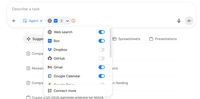
For ChatGPT agent specifically, current governance capabilities remain limited. While enterprise clients can centrally control connectors and define access policies, the platform, in its current beta phase, lacks role-based access control (RBAC) and compliance APIs for connector management.
Compounding the governance challenge are shadow IT risks, with employees potentially using personal ChatGPT subscriptions with enterprise credentials in what the analyst firm warned could create “significant data leakage risks” while enabling potential attackers to abuse access.
Instead of businesses turning their heads to gawk at OpenAI’s shiny new toy, Gartner wants enterprises to instead employ a portfolio-based strategy that evaluates each agent's unique value against existing specialized tools to avoid potentially unmanageable complexity.
The case for purpose-built networking agents
ChatGPT agent is still in its infancy, but that doesn’t mean the networking world hasn’t already seen an influx of agentic offerings.
Just last week, SDxCentral broke the news that Articul8, the generative AI Intel spinout, unveiled a Network Topology Agent capable of creating a queryable graph of entire networks.
Days earlier, Extreme Networks launched its own network visualization offering, while in June, HPE added agentic AI management capabilities to its GreenLake platform to provide root-cause analysis for network issues. And in the past week, Nokia revealed a series of lightweight, specialized software modules for telecom operators to help manage networks without the need for human input.
While ChatGPT agent is a general-purpose AI system, the offerings from Articul8 and Extreme Networks are highly specialized, built with industry-specific data to perform industry-specific tasks.
Siân Morgan, Dell’Oro Group’s research director for campus networks and enterprise WLAN markets, told SDxCentral that the most efficient and accurate agents for the networking space will come from IT vendors and not OpenAI.
“For instance, Cisco is using their own large language model that was purpose-built for networking, and they claim that with this smaller model, they are 20% more accurate than a general model,” Morgan said. “IT vendors have access to a wealth of information about network designs, bugs, and configuration problems that can be used to efficiently train smaller, focused network operations models."
Some of these emerging tools are designed to be switched on, given their marching orders, and off they go, while others require a human in the loop to make final decisions on potential changes to network systems.
Morgan said that while these agentic systems can enhance troubleshooting and optimize performance, enterprise IT leaders need to consider what level of autonomy they want such tools to have.
“Do they want to keep a ‘human in the loop,' making the final decision before any network change is made? Or are they comfortable with the agent making changes and informing after the fact? The answer to this question may change over time as the IT teams gain a better understanding of the AI agents’ capacities and limitations," Morgan said.
The other key impact of AI agents in the networking market was the ability to perform a variety of tasks.
“These agents can be purpose-built for specific business operations or can be general-purpose agents performing tasks such as creating presentations or developing code," Morgan explained.
The proliferation of multifunctional AI agents could fundamentally alter enterprise network demands.
“The wide use of agents will likely shift traffic patterns on the campus network and may require enterprises to invest in networking equipment to improve performance and lower latency," Morgan added.
However, Morgan cautioned that the networking industry is still operating in uncharted territory. “Since we are just at the very early stages of agentic AI, no one really knows the volume and characteristics of the agents that will be out there, so it's impossible to definitively state what the network impacts will be," Morgan said.





Comments