

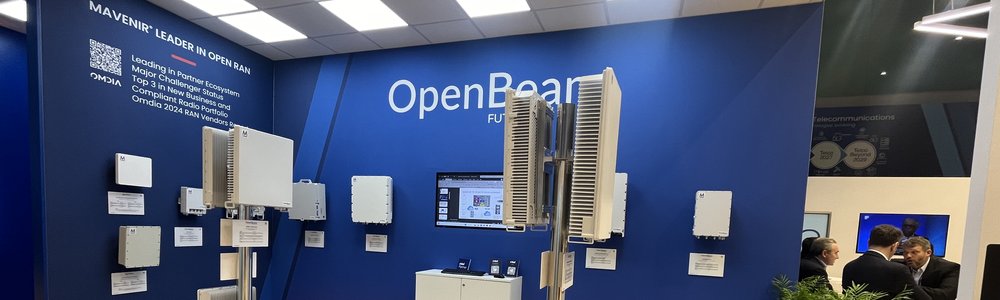
Mavenir exited last year with some much-needed momentum that could see the Texas-based open radio access network (RAN) vendor ride a growing focus by operators in deploying open RAN equipment, though it also lost a prominent executive that could hint at ongoing internal operating challenges.
AT&T provided the most significant recent push as the telecom giant added Mavenir as an official open RAN equipment supplier to AT&T’s ambitious $14 billion open RAN initiative. The agreement will see AT&T use Mavenir along with Fujitsu open RAN radios to run on top of its Ericsson-based open network platform.
AT&T has provided a goal of having 70% of its wireless network traffic flowing through its open RAN platform by the end of 2026.
More importantly, the carrier lauded the technological maturity of its new vendor partners. AT&T COO Jeff McElfresh explained during a media question-and-answer session that network testing showed the two vendors as being “a little bit more advanced, little bit more mature, I should say, in their technology.”
That sentiment was significant for Mavenir, which has been battling for a sustainable foothold in the open RAN ecosystem.
The vendor has been touted as a leading open RAN player by several analyst firms. This was backed by Mavenir’s early success in greenfield deployments highlighted by its work with Dish Network, and more recent success with brownfield deployments.
Stéphane Téral, founder and chief analyst at Téral Research, hinted at Mavenir’s underground progress in a recent report.
“While working on specific projects in [the third quarter of 2024], we unexpectedly found Mavenir in many places around the globe but due to NDAs [nondisclosure agreements] in place, we cannot reveal the deals,” Téral wrote.
However, Mavenir’s operations have continued to wobble. This has been highlighted by ongoing financial struggles that resulted in one ratings firm recently slashing Mavenir’s outlook.
“Weak operating performance is straining cash flow and liquidity,” S&P Global noted in late October. “We attribute Mavenir's underperformance to weakness in its key customer revenue and high research and development expenses in the Mobile Access & Edge (also known as open RAN) business, which we expect will continue in the near term. Despite its cost-saving initiatives, Mavenir must maintain high R&D spending to avoid harming its competitive position. While the company raised $100 million of equity capital last year, we believe it will need an additional $120 million to cover its cash outflow over the next six months and the upcoming maturity in January 2025.”
More recent published reports have indicated that Saudi Arabia’s Aramco Digital is looking at a potential $1 billion investment in Mavenir, which could help stabilize near-term financial concerns.
Mavenir could also see a boost from the U.S. federal government’s recent approval of additional funding to pay for its extensive “rip-and-replace” program. That initiative is officially known as the Secure and Trusted Communications Networks Reimbursement Program and emerged from the Secure Equipment Act of 2021, and is targeted at removing legacy equipment from China-based vendors like Huawei and ZTE due to security concerns.
“Rip-and-replace is only funded to 40% of the money,” John Baker, SVP of ecosystem business development at Mavenir, testified in front of a congressional panel early last year. “People like Mavenir that have participated in that … we’re still outstanding in the completion of that activity to get the Chinese equipment out of our networks. There’s still Chinese equipment in the networks waiting for this funding to take place.”
However, Baker will not be part of that potential funding opportunity at Mavenir as the executive recently left the vendor.
“John Baker has decided to move from Mavenir to pursue alternate paths and platforms to continue his industry and open RAN evangelistic efforts,” Mavenir noted in an email response to SDxCentral. “We look forward to continuing to work and partner with him to help the industry continue to realize the gains and value from open RAN.”
How important is Mavenir to open RAN?
Analysts view Mavenir’s stability as an important vector for the broader open RAN market.
“Our belief is that open RAN’s success and future prospects hinge on the survival of Mavenir,” Michael Thelander, president and founder of Signals Research Group, noted in a recent report.
While the overall space continues to underwhelm, there are signs of progress.
Dell’Oro Group recently reported that revenues related to the sale of open RAN equipment would plunge for all of 2024.
“Short-term projections have been revised downward, while the long-term outlook remains unchanged,” the firm noted. “Open RAN is now projected to comprise a mid-single-digit share of the 2024 RAN market and 8% to 10% of the combined proprietary plus open RAN 2025 revenues.”
That near-term outlook did follow a more longer term growth forecast that open RAN equipment will account for more than 25% of the total worldwide RAN market by 2028. North America is expected to lead that growth, with the overall open RAN share predicted to be as high as 40% of the total RAN market when taking early adopter China out of that equation.
Analysys Mason is even more positive on market growth predicting open RAN and virtualized RAN (vRAN) architectures will account for more than 70% of segment vendor revenues by 2030.
Mavenir’s inclusion in AT&T’s open RAN work and the boost that deal might have toward solidifying its technical reputation could position the vendor to take advantage of that growth opportunity.
ABI Research ranked Mavenir alongside rivals NEC and Nokia as leading open RAN vendors based on innovation and implementation metrics, however Dell'Oro Group notably left Mavenir out of its ranking of open RAN vendors that was based on revenues generated through the first nine months of 2024.
Despite the challenges, analysts remain optimistic.
“Mavenir has its challenges both financially and customer wise,” Recon Analytics wrote in a LinkedIn post following Mavenir's investor conference. “The company has loan obligations it must meet that have an impact on its approach to business. Concurrently, CSP network investments since the end of 2022 have been contracting. However, Mavenir appears to be doing better riding out this investment contraction cycle contraction than some of its more established competitors. Mavenir’s commitment to open and cloud native networks is helping the company to ride out this difficult investment cycle.”
Comments