


Fiber networks are running out of runway. With AI workloads exploding, and enterprise and consumer demand surging in parallel, aging passive optical infrastructure is nearing its limits.
Enter coherent optics: an advanced optical transmission approach that uses both the amplitude and phase of light to boost both capacity and transmission reach.
Coherent passive optical network (CPON), which combines advanced modulation techniques to transmit high-speed data over long distances, has the potential to usurp its more traditional counterpart, but that dethroning has yet to occur.
With the need to move exponentially more data at higher speeds over longer distances, is CPON finally ready for primetime? Can new materials, architectures, and standards push CPON from research to real-world deployment? SDxCentral sat down with experts building devices, materials, and standards to find out.
But first: What is PON?
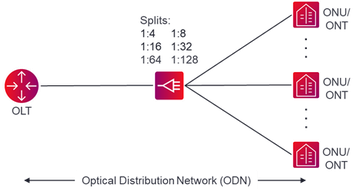
A quick outline for those not familiar with passive optical network (PON) topologies.
PON is a fiber-optic technology that uses a point-to-multipoint architecture to transmit data from a centralized source, typically an optical-line terminal (OLT), to multiple endpoints via optical splitters.
For the less technically minded, think of PON as a data transmission highway that branches into smaller roads to reach individual homes.
In contrast to active Ethernet, which spreads switches across a local area network (LAN), PON systems feature a single hub and no active electronics in the distribution network.
PON is largely applied as a last-mile solution – with internet service providers (ISPs) using these single fibers to serve several end-users on the same system.
What’s breaking PON: The coming capacity crunch
We’re in a period of unprecedented power consumption brought on by rapid GPU cluster buildouts. Everyone from hyperscalers like Microsoft and Meta to investment giants like Blackstone are jumping to take advantage of the AI boom, pushing data center capacity limits.
Global demand for data center capacity is projected to increase up to 22% annually between 2023 and 2030, according to McKinsey research. Such a surge could result in an annual demand of up to 219 gigawatts (GW) of power, surpassing Egypt's total annual electricity output in 2023 (218.54 GW).
That capacity crunch is cascading down to the access layer, where PONs operate. For example, total fiber broadband connections in Organization for Economic Co-operation and Development (OECD) nations grew to 211 million at year-end 2023, a 73% rise compared to 2019.
That number is only going to grow in the coming years, with demand for high-quality broadband to fuel increasingly intense applications like streaming high-definition content.
Traditional PON architectures were built for a different era, and are already hitting limits in terms of bandwidth per wavelength, reach, and especially upstream scalability. When adding those intense workloads on top, the already exacerbated cracks in legacy systems are widening, and as a result, systems are buckling under the pressure.
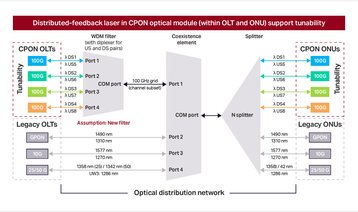
So, what is CPON? And how can it help here?
Unlike traditional PON, which uses intensity modulation-direct detection (IM-DD) – where the intensity of a light beam is varied to represent data, and then directly detected by a receiver – CPON uses more advanced signal modulation and detection methods to transmit far larger amounts of data over much longer distances.
CPON is lined up to be the next generation of passive optical networks, able to support both upstream and downstream bandwidth for demanding applications like 5G backhaul and high-speed internet.
What makes CPON potentially disruptive is its ability to overcome the fundamental distance-versus-density trade-off in legacy PON systems. Traditional deployments forced operators to choose: extend reach to serve far-flung customers, or densify to increase capacity closer to the edge, but not both.
With coherent optics entering that equation, the technology has the potential to dramatically improve optical sensitivity and spectral efficiency, and to support high-capacity links to greatly expand that last-mile network, with less power, and without the need for amplification.
Can it scale?
Among those looking to help CPON reach its full potential is CableLabs, the research and development lab for the broadband industry. Since around 2020, the nonprofit has been researching and standardizing coherent PON technologies to understand how it can be adapted for access networks.
Back in 2023, CableLabs unveiled one of the first architectural specifications for CPON, showing how it could be applied to point-to-multipoint access networks. The group’s goal was to enable 100 Gb/s services over a single wavelength to multiple endpoints – that’s far beyond what traditional PON systems deliver today.
According to Matt Schmitt, a distinguished technologist at CableLabs, that 100 Gb/s headline figure isn't the real story.
"To me, what I think is exciting about [CPON], is less to do with the capacity," Schmitt told SDxCentral. “When you go to coherent, you’re increasing your link budget significantly, you can do much higher split ratios, or serve much more distant customers ... you don’t have to put OLTs out in the field anymore.”
Such a shift would have some significant architectural implications, like allowing operators to collapse access and metro layers, remove active components from the field, and centralize operations – ultimately lowering capital and operating costs.
The team at CableLabs are working to publish formal specifications for CPON before the OFC 2026 event, in what would lay the foundation for a potential multivendor ecosystem. The goal is to create an open environment for interoperable standards-based solutions, and ultimately encourage broader adoption.
For Schmitt, the million-dollar question is when are we going to see CPON products? He suggested that if vendors were able to deliver coherent systems at only a modest premium over 50G PON, they’d be able to skip generations and jump straight to 100G coherent deployments.
“Skipping over 50G might look kind of interesting, because you're getting that extended reach, the higher split ratios, and more capacity, but you're not necessarily paying double the cost for it,” Schmitt said. “Will it happen? I don't know. It's really going to come down to what [hardware developers] are able to do. Design wise, it's amazing how coherent technology has matured.
Schmitt explained that when CableLabs was doing the point-to-point specifications, "the assumption was you needed these big modules. Now we have companies putting out 100G coherent point-to-point on a QSFP28. And with that, the costs have come down dramatically.”
Material innovation: NLM Photonics
To make CPON a reality, coherent hardware developers need the right tools for the job. Enter a University of Washington spin-off that’s working to create organic electro-optical materials that could help power those next-gen PONs.
NLM Photonics brought together minds that have been examining and refining work on organic electro-optical materials – which can be applied to coherent hardware used to support PON systems – for more than two decades.
The spin-out is working on ways to give electro-optical polymers a higher thermal stability to minimize stress and strain due to temperature fluctuations and ultimately keep devices running for longer periods with fewer failures.
Having worked with NASA and the U.S. Air Force, the NLM team set its sights on using its material expertise to improve modulators in silicon photonics.
“Typically in silicon, photonics doesn't have really good properties,” NLM Photonics CEO Brad Booth explained. “They use a silicon oxide in there, and it's brute forcing the modulator to actually try to modulate light. What happens is you spend more power and do a lot of extra work to make that happen.”
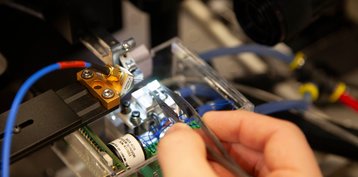
What the folks at NLM do is instead offer their own specially designed materials for transceivers in photonic integrated circuits that offer far higher electro-optical responsivity, enabling devices to modulate light more quickly and more energy efficiently.
And it’s not just about power, with Booth outing that with the right material, device operators can greatly reduce the form factor of hardware, while increasing speeds – a Moore’s Law-esque consideration not commonly applied in the world of photonics.
“We did a 1.6T pic, which is eight lanes running at 200G in silicon photonics, and then did our post processing," Booth explained. "That device, if we had done it in a standard silicon photonics process versus ours, our device is 40% smaller. That's a pretty massive size difference. We're bringing the ability to scale these devices down.”
With devices capable of transmitting cleaner signals with higher quality, NLM’s material know-how could help transform how data is transmitted over PON networks. Coherent hardware built using materials like the ones being developed at NLM could help improve transmission efficiency while reducing both form factor and power requirements.
“If you look at PON today, the data rates are not incredibly high, at least for the end devices. But if you could imagine those being 100 gigabits per second or 200 gigabits per second on each of those, that's some serious bandwidth that you have to start moving,” Booth outlined to SDxCentral.
Among its newest materials are Selerion-BHX, a thermoset offering that the startup claims offers “exceptional” electro-optic performance for optical input-output, co-packaged optics (CPO), and even space-based applications.
Despite being a material some hardware manufacturers haven’t handled before, NLM’s offerings can be integrated into slot-waveguide electro-optical modulators in photonic integrated circuits, making them compatible with existing process flows.
“If you start looking at some of these materials, the ability to use them can change the quality and potentially even change the reach capabilities of these networks,” Booth added.
The right material could even mean that coherent device developers can do away with the often tricky task of integrating on-chip lasers made from incompatible materials.
Photonic hardware used in coherent systems often features on-chip lasers, which have to be added to the silicon, but given material incompatibility, integration can oftentimes lead to structural defects and high signal losses.
While researchers have sought to get around this through methods like fabricating lasers directly onto a photonic chiplet, Booth elaborates that the challenge with laser integration impacts the ability to generate light.
“Silicon is crappy at creating light,” he explained. “It's good at electrons, but light, it's not very good at. Some materials that generate light, like indium phosphide, and while good at it, but they're not extremely efficient.”
Booth suggests that NLM’s technology could potentially help integrate III-V materials like indium phosphide with silicon photonics more effectively, improving overall laser and modulation performance.
While the firm isn’t specifically chasing the PON market, anytime a hardware designer wants to modulate light, NLM wants to support them, with Booth outlining to SDxCentral that the spin-out is looking at taking its patent portfolio to applications in coherent devices, as well as millimeter wave, and eventually quantum.
Booth emphasized that NLM is "agnostic to the underlying platform" and is willing to work with anyone needing high-frequency modulation, whether they’re looking at PON, or beyond.
“Our goal, long term, is that NLM is building intellectual property, designing new materials, and then that just shows up in the industry through our partners and other vendors that we're working with,” Booth added.
Market dynamics and adoption curve: What’s next for CPON?
While coherent optics has started to redraw the map when it comes to long-haul and metro networks, CPON isn’t quite there yet. And it won’t be for a while.
“PON will lag somewhat in terms of adoption,” David Rothenstein, chief strategy officer at Ciena, explained. “You're taking advanced modulation and detection techniques that work beautifully in the core and applying them to the access layer, but the macro factors driving fiber upgrades just haven’t kept up.”
Among those factors Rothenstein outlined to SDxCentral include the long-promised shift from coax to fiber in the cable world, something that’s slow going, along with the further delayed U.S. government subsidies meant to close the digital divide via the Broadband Equity, Access, and Deployment (BEAD) program. Continental cousins in Europe are no faster either.
But that doesn’t mean CPON is standing still. Ciena’s Rothenstein sees the technology fitting into a broader architectural shift that’s already underway, thanks in part to the explosion of AI infrastructure that, as established earlier, is putting the strain on campus-scale and metro networks.
“In WAN, coherent overtook IM-DD once we crossed 100G,” Rothenstein explained. “The same thing is now happening closer to the edge. IM-DD becomes lossy. It can’t handle the reach, capacity, or power requirements as data center campuses scale out.”
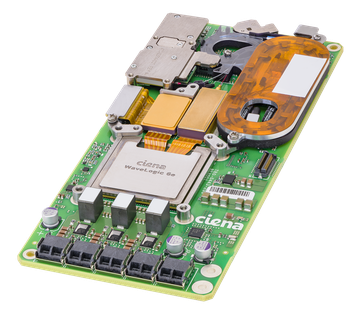


For Ciena, the firm is already shipping 1.6 Tb/s coherent optics with WaveLogic 6 Extreme and has announced WaveLogic 6 Nano Coherent-Lite. WL6n Coherent-Lite is tuned for metro and edge data center interconnects (DCI) while cutting down functionality to suit shorter distances and tighter power envelopes. That tuning, Rothenstein suggested, could eventually carry over into access deployments should the economics line up.
“The new AI infrastructure is consuming just unprecedented amounts of power,” Rothenstein explained. “So you have to distribute the compute functions in the data centers across multiple locations, further and further apart. Otherwise, the stress on the existing power grid is too much. That drives the need for more interconnects between data centers, and that’s where coherent comes in.”
CPON is coming. But it won’t scale because of some killer app or flashy demo. Instead, what’s next for CPON is scale when it becomes practical to do so as part of wider network buildout. As Rothenstein surmised: “It’s not about power anymore. It’s about where the fiber is. And we’re seeing infrastructure expansion at a scale the industry hasn’t seen in decades.”
Comments