


New market analysis from IDC suggests that demand for wireless LAN (WLAN) is continuing to grow, with the market increasing by 10.6 percent in the first quarter of 2025.
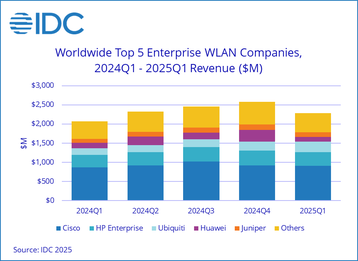
IDC’s latest "Quarterly WLAN Tracker" suggest the global enterprise WLAN market reached $2.3 billion in Q1, as stability begins to take shape following several years of volatility due to backlogged orders brought about by the pandemic.
The latest WiFi standards are among the leading drivers of WLAN market growth, with WiFi 6E accounting for 31.9 percent of revenues in the dependent access point market segment, compared to 27.7 percent a year earlier.
Demand for WiFi 7, or IEEE 802.11be, also increased in Q1, accounting for 11 percent of the segment’s revenue, up from 10.2 percent sequentially. The standard emerged last January, with increasing numbers of devices receiving certification in recent months.
WLAN enterprise revenues for big-name vendors all rose, with market leader Cisco reporting a 4.6 percent year-over-year (YoY) increase to reach $904.5 million, and garnering a 39.5 percent share of the market.
Rivals, including Hewlett Packard Enterprise (HPE)/Aruba Networking, Juniper Networks, and Ubiquiti all saw WLAN revenues increase, while Huawei saw a 10.7 percent YoY drop.
In terms of geography, IDC reported that the Americas enterprise WLAN market saw a 15.2-percent increase, with the US reporting strong growth of 21 percent compared to the same period last year.
Across Europe, the Middle East, and Africa (EMEA) the WLAN market grew 11 percent YoY, while Asia-Pacific revenues grew by just one percent YoY, which was impacted by a 4.2-percent drop in sales from China.
“The enterprise WLAN market continues to reset after a volatile period of annualized growth rates, driven by complex supply chain disruptions and inventory management issues impacting both vendors and end users," Brandon Butler, senior research manager for enterprise networks at IDC, explained in a statement. “The fundamentals of the enterprise WLAN market remain strong, however, with exciting innovations such as 6 GHz WiFi and AI-powered management capabilities continuing to power the next-generation of wireless connectivity.”





Comments