

Viasat selected Rocket Lab to build the geosynchronous (GEO) satellite bus for a small GEO satellite Viasat will produce for the U.S. Space Force (USSF) Space Systems Command under its Protected Tactical SATCOM-Global (PTS-G) program, which itself possesses $4 billion indefinite delivery indefinite quantity (IDIQ) ceiling value.
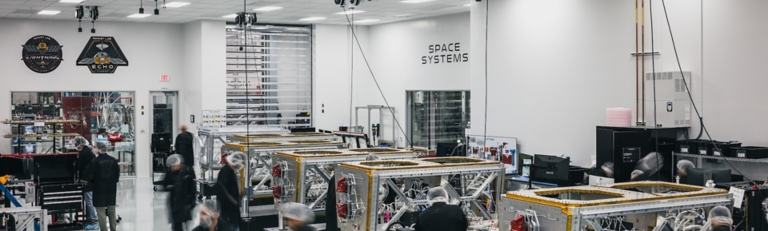
Rocket Lab will contribute its Lightning spacecraft platform, a satellite bus supporting high-power satellites – roughly three kilowatts – supporting a dual X- and Ka-band payload featuring anti-jam, resilient capability to be integrated by Viasat. The Lightning satellite bus was also the foundation of eight Globalstar HIBLEO-4 satellites, which recently completed an orbit raising.
“By combining Viasat's cutting-edge communications payload technology with Rocket Lab's proven spacecraft platform, we are advancing a more agile and resilient GEO architecture designed to support mission-critical communications hot spots in contested environments," Viasat Government President Craig Miller explained. "We are excited to showcase how low cost, high performance dual-use technology can provide reliable connectivity for evolving missions in an increasingly contested tactical communications environment."
Viasat earlier this year was granted a Swarm 1 prime contract to deliver one of the PTS-G’s first small, maneuverable GEO satellites, including manufacturing, integration, test, launch, and on-orbit diagnostics. The PTS-G contracts, which were also granted to SES, amounted to $437.6 million.
The contracts were shortly followed by a $2.29 billion USSF deal with SpaceX for the Space Data Network, a communications “backbone” for future U.S. military communications.
Viasat’s Swarm 1 award is one of two delivery orders from Space Force under a Fair Opportunity acquisition, an initiative created to develop a diversified architecture for PTS-G between developers competing for the best standard. As part of the award, Viasat has been tasked with five years of operations and sustainment for the satellite including telemetry, tracking and command, satellite and network operations, and cybersecurity.
"Moving from design into production marks an important milestone for this program and for Rocket Lab's growing role in national security space,” Rocket Lab CEO Peter Beck noted. “By pairing our vertically integrated spacecraft with Viasat's protected communications payload, we're delivering resilient, space-based communications infrastructure that keeps our forces connected and secure in contested environments."
There is no guarantee that the vertically-integrated satellite in question will be launched by Rocket Lab, which has so far played a definitionally non-verticalized role in these satellites’ supply chain.
Rocket Lab in GEO?
On a more verticalized note, the USSF’s Space Systems Command also contracted Rocket Lab to design, manufacture, integrate, and operate two space domain awareness (SDA) GEO satellites with its Lightning satellite bus for $90 million, satellites that will be equipped with payload manufacturer GEOST’s Heimdall payload. GEOST was acquired by Rocket Lab in 2025 after being contracted by the USSF to prototype the Heimdall SDA payload.
Rocket Lab is also on the hook for five years of on-orbit operations. The satellites will be assembled, integrated, and tested at the company’s Long Beach, California Spacecraft Production Complex.
Rocket Lab heralded this USSF contract as the first satellite production award for GEO orbit, which demonstrates the company’s multi-orbit, verticalized capacity.
Rocket Lab is also navigating the acquisition of satellite operator giant Iridium, which it bought June 29 for $8 billion.





Comments