

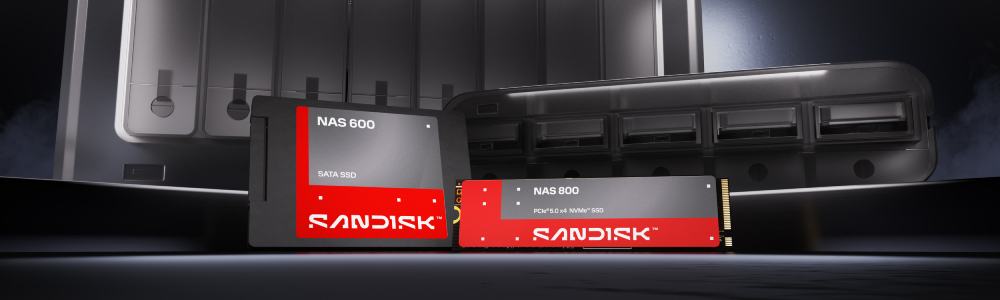
Sandisk released a set of high-endurance solid-state drives (SSDs) designed for network-attached storage (NAS) environments.
According to the memory maker, the Sandisk NAS 600 SATA SSD and the NAS 800 NVMe SSD two-punch comes designed for accelerating hybrid plus all-flash NAS systems, as well as supporting high-speed private cloud deployments leveraging NAS.
The NAS 600 SATA SSD is available in models from 500 gigabytes (GB) up to four terabytes (TB), delivering up to 2,500 terabytes written (TBW) with its 4TB model, and up to 2.25 million hours mean to failure (MTTF) to support demanding multi-user workloads. The drive's 2.5-inch serial advanced technology attachment (SATA) form factor integrates into existing 3.5-inch NAS drive bays supporting 2.5-inch SSDs.
Sandisk’s NAS 800 focuses on non-volatile memory express (NVMe), supporting PCIe 5.0 and coming in capacities from 960 GB to 7.68 TB. The SSD delivers 14 petabytes written (PBW) with the largest model for caching, storage tiering, or use as primary storage. It also handles 2.3 million-read/two-million write input/output operations per second (IOPS) with random read/write speeds of up to 3.84 TB and sequential read/write speeds up to 14,900/13,200 million bytes per second.
The SSD was pitched as suiting multiuser collaborative environments, databases, virtualization, content creation, and agentic AI use. Sandisk joins the likes of StorOne and others in pitching advanced flash-based wares as AI compute massively increases the amount of data needing to be stored, organized and rapidly supplied back to workloads.
"The way users employ NAS has fundamentally changed," Anil Moolchandani, VP of product management at Sandisk, noted. "Today's prosumers, creative professionals, and small businesses are managing larger datasets, collaborating across teams, and relying on systems that need to perform around the clock. We built the Sandisk NAS portfolio to meet those evolving demands, giving users SSDs that make it easy to modernize existing NAS environments or unlock the performance of all-flash deployments."






Comments