


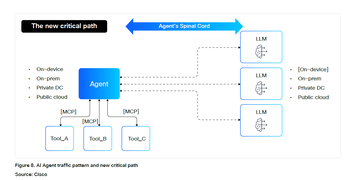
Cisco published a new report arguing that AI inference and agents will fundamentally reshape wide area network (WAN) traffic patterns over the next decade, finding that 450% more total traffic is generated per task when performed by an AI agent than a human performing the same task manually.
The "AI Impact on Wide Area Networks" report is based on real-world traffic data with an early insight into agentic AI traffic, in a bid “not to predict distant sci-fi futures or summarize what everyone already suspects about AI," according to its authors.
Key figures from the report claimed approximately 70% of agent-generated traffic is AI inference. Token-consumption data showed nearly 10-times year-over-year growth, while approximately 9% of AI inference in general carried more upstream than downstream traffic, compared with about 0.5% of typical web traffic. This is due to larger, context-rich prompts.
As models generate responses token by token, median flow duration for AI inference traffic is twice as long as regular web transactions, measuring 1,292 milliseconds versus 643 milliseconds for non-AI traffic. Cisco also projected AI inference traffic to account for 25% of all network traffic by 2035.
'80 billion' fake humans to robotic manifestation
While the headline figures echo earlier warnings from Cisco about a bandwidth blitz from agents equivalent to “80 billion” humans, the new report found that AI is not simply adding more traffic to the internet but changing the shape of WAN traffic itself.
“AI will not just increase traffic volume – it will change traffic shape, symmetry, duration, and criticality,” Gurudatt Shenoy, SVP of product management at Cisco, and Javier Antich, principal product management engineer at Cisco, wrote. “AI inference paths will become strategic network assets, requiring higher resilience, greater observability, and differentiated treatment, including quality of service and path security.”
Cisco also concluded that network latency is not yet the primary bottleneck for AI inference, explaining inference latency remains dominated by model processing times measured in hundreds of milliseconds or multiple seconds, versus roughly 20 to 50 milliseconds for network latency. Cisco cited examples where OpenAI GPT-5.2 inference may require roughly nine milliseconds per generated token, while Anthropic Claude Opus 4.5 could require about 20 milliseconds per token.
Also, while vendor chatter about AI agents may imply their use is already ubiquitous, Cisco said agentic AI still exists in experimental deployments, with a standard enterprise operating model due next decade.
Cisco projected enterprise network traffic would grow roughly 2.5-times between 2026 and 2035 without agentic AI, but could instead increase approximately nine-times once adoption of autonomous AI workflows becomes widespread. The researchers added overall internet traffic would grow 4-times from 2025 to 2035 without AI impact, but 6.6-times once AI and agentic AI adoption are factored in, representing an additional 63% increase beyond baseline projections. Cisco expects the most aggressive growth period to occur between 2029 and 2032, when AI inference traffic compound annual growth rate (CAGR) could approach 25%.
Beyond agents and toward a more sci-fi future, Cisco also expects that physical AI and robotics will create another major networking inflection point as industrial and consumer robots increasingly combine embedded inference with cloud-based reasoning systems. Robots, it said, should effectively be viewed as “physical agents equipped with tangible tools” whose networking impact could mirror that of digital AI agents.
Despite the incoming influx of digital and physical agents, Cisco is still banking on humans by equipping tomorrow's engineers with the AI skills needed to weather this oncoming storm. This week the networking giant launched AI-led updates to its certification portfolio, redefining the blueprint of the Cisco Certified Networking Associate (CCNA) to reflect the role of AI in network management and operations as they stand today.







Comments