

ST. LOUIS – Quantum computing remains a work in progress, but one of the bigger challenges toward perfecting the technology remains getting a handle on errors generated by such high-powered compute systems.
Quantum computing is greatly impacted by so-called “noise” that is anything that affects operations that are being performed on quantum computers. That noise can be something that causes information loss or errors and can be due to decoherence, material defects, and other disruptions in the environment.
This can be especially challenging in quantum systems that rely on qubits, which are a two-dimensional version of traditional computing bits that can simultaneously represent “0” and “1” in a computing model.
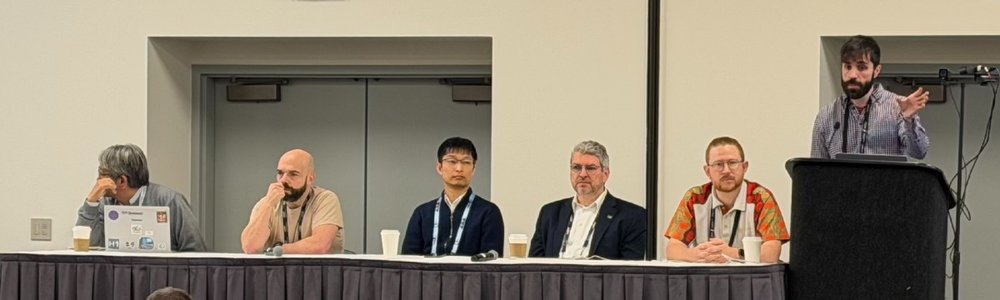
“Error” was a repeated term during a quantum computing-focused panel at this week’s SC25 event in St. Louis, as panel members noted error mitigation efforts continue to be the biggest hurdle in their work.
That was most succinctly noted by panel moderator Ermal Rrapaj, a quantum researcher and computer systems engineer in the Advanced Technologies Group at Lawrence Berkeley National Laboratory, who stated that, “without error correction you will not have a computer.”
“A computer that the user can use,” Rrapaj added. “They'll have to learn how to interact with it. They'll have a software cycle available. They'll have a language, even primitives, but they have to have the computer fully working.”
This led to Rrapaj asking the panel members to “tackle the elephant in the room, which is error correction.”
Antonio Córcoles, a principal research scientist at IBM Quantum, noted that a big challenge to tackling quantum errors is in the delicate nature of qubits.
“When you run a computation on a quantum computer you cannot stop it and look at how it is going, because then you project the qubits, and then you lose all the entanglement and superposition,” Córcoles explained. “So since you cannot stop the computation, you cannot ask the qubits what the state you are in?”
Córcoles did note that this can be worked around by instead asking the qubits a different question: are you all the same, or are you all not the same?
“In order to ask those questions, you add other qubits that are going to ask those questions that are redundant,” Córcoles said of that process. “So you need a bigger system than the one that does the computation. And you need to ask those questions very often.”
That frequency generates a lot of data to parse through and a powerful decoding process to get the required answer. This is a complex process that today leans on approximation, which in turn leads to the need for a greater error budget.
Yuval Boger, chief commercial officer of QuEra, highlighted this budget need by noting, “today, the state of the art in qubits is that you can perform somewhere between 1,000 or maybe some say 10,000 operations before you have an error. And that sounds like a lot. But if you have a really serious calculation that has millions and millions of operations, you're almost guaranteed to get junk at the end, just because of these statistics.”
Tackling quantum errors
Boger did point toward efforts being made in attempting to counter this challenge, specifically noting work QuEra did with Nvidia where they trained machine learning models running in classical HPC systems to do the decoding.
“What Nvidia believes is the case is that when these codes get more and more complex, then machine learning is going to outperform classical algorithms for error decoding,” Boger said. “I don't know if we would need an HPC center to do the decoding, but I think it's clear that quantum and classical computing is going to have to work hand-in-hand to make this work.”
Kentaro Yamamoto, a research scientist on the quantum chemistry team at Quantinuum, added to this thesis, postulating that HPC could be one way to help support quantum error correction.
“Quantum error correction requires very fast communication between some type of hybrid, some type of HPC,” Yamamoto said. “It could be special purpose HPC right next to hardware. It could be the existing hardware, existing HPC, if we can wait a bit longer. The obvious challenge is to minimize latency between these two and also try to speed up all the calibrations.”
Yamamoto added that Quantinuum recently released new hardware code with a real-time engine that allows the decoding to decide what to do based on measurement results.
“We started with very small code, and this will definitely [not] need the HPC, but potentially we will eventually realize that, ‘oh, we need more qubits to encode information, to protect that quantum information for a long time,’” Yamamoto said. “And depending on the size of the code, the small HPC right next to quantum hardware, then we may want to use the big HPC at some layer. … It could be a higher layer or it could be the lower layer. And due to the nature of the ion trap, our device is slow, but on the other hand we can make use of this slow, but long coherence time to play with a bit bigger HPC while it's running.”



Comments