

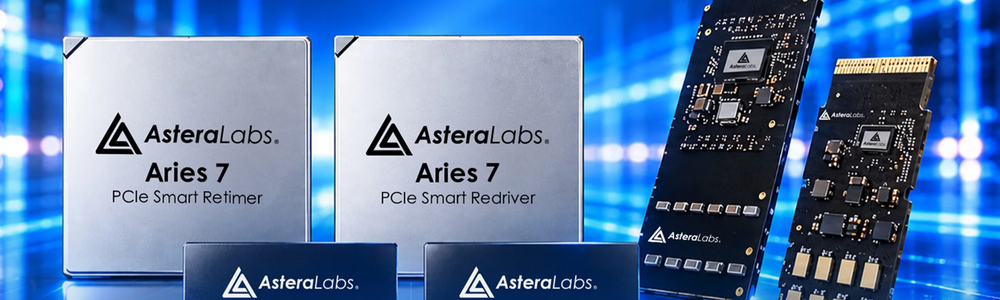
Astera Labs unveiled Aries 7, what it claims to be the industry’s first signal conditioning portfolio spanning both copper and optical links for the peripheral component interconnect express (PCIe) 7 standard.
Signal conditioners clean up and extend signals for PCIe links that interconnect accelerators, memory pools, networking ports, and storage. The specification was unveiled in June 2025, and sees PCIe 7 run at 128 gigatransfers per second per lane – double that of the previous generation. But as speeds are getting faster, Astera warns that doubling data rates ultimately shrinks signal margins.
Amid growing interest in switching from copper to optical connectivity, the vendor’s new addition to its signal conditioning portfolio wants users to carry on with copper where most efficient, while providing the means to move to optical “where reach demands it.”
Astera said the Aries 7 portfolio extends reach from centimeters to more than 50 meters over optical cables spanning multiple racks. The vendor did not, however, offer up numbers covering power or latency in its announcement.
Tapping the “smart” technology Astera introduced on its Taurus line of Ethernet modules earlier this year, Aries 7 smart retimers and smart redrivers share the same Open Compute Project (OCP) signal conditioner standard footprint. Retimers typically offer more reach, while redrivers use less power and add less latency. Aries contends customers can now design a signal conditioner board and swap in either chip later as their workload requirements change, without complete redesigns.
“The real question for architects isn’t retimer vs redriver, or copper vs optical: it’s whether they have one comprehensive toolbox with the optionality to pick the right tool for their evolving reach, density, and power requirements,” Adit Narasimha, SVP of Astera’s signal connectivity group, explained. “That is what we built with Aries: the same intelligence and the same software, for the solution the link needs.”
Sampling is set to start by the end of the year for select hyperscale, OEM, and near package optics (NPO) customers, with broader availability “as platforms complete qualification.”
Chip giants AMD and Intel validated earlier Aries retimers in production from PCIe 4 through 6 and are “collaborating” on PCIe 7, the vendor said, while optical players like Lumentum and Lumilens were quoted as partners in Astera’s release.
“Linear optics works at scale only if the electrical and optical halves of the link are designed together from the start," Lumentum CTO Matt Sysak noted in a statement. "Pairing our photonic engines with Astera Labs’ Aries 7 smart optical driver and TIA lets us hit the reach and density targets that multirack AI fabrics need, without the power and latency penalties of a retimed optical module."
“The OCP signal conditioner standard footprint was built to be protocol-agnostic, and extending it from Taurus’s Ethernet and UALink applications to the Aries PCIe portfolio is exactly the kind of industry-wide adoption we hoped to see,” OCP CTO Zane Ball added. “One common footprint spanning multiple protocols means hyperscalers can design their boards once and rely on multivendor sourcing as their fabrics evolve, instead of resolving the same integration problem for every new interconnect.”




Comments