


Quantum technologies are starting to enter the enterprise network stack, not through futuristic hype, but through practical optimization, security, and connectivity trials already underway. Telecom operators, data center operators, and network researchers are beginning to evaluate how quantum-based capabilities can solve real problems: making networks more efficient, protecting encrypted data, and eventually linking distributed quantum devices.
Across the ecosystem, the momentum does not point to a single breakthrough. It looks more like a set of overlapping migrations. Comcast and Classiq are testing how quantum workflows could accelerate broadband capacity planning. U.K. startup Phasecraft is turning hybrid quantum-classical optimization into a deployable software platform. Nokia is working with operators to secure brownfield fiber networks against future decryption risks. And CERN’s quantum testbed is exploring how to weave entanglement into fiber links that already carry classical data.
Together, these projects suggest that quantum is not here to replace networks, but to augment them, one use case at a time.

The Quantum Supplement
The cryptographic race against quantum decryption
Quantum-accelerated network optimization
Comcast is exploring how quantum computing might make large-scale broadband networks more efficient. The company has created a quantum research lab to investigate optimization challenges, such as traffic management and fault prediction, where classical and AI-driven systems already assist but cannot always find the best solution quickly enough.
Two quantum technology partners are running separate experiments. D-Wave Quantum is using quantum annealing to explore near-term resource allocation problems, focusing on use cases that fit today’s available hardware. Classiq, by contrast, is applying gate-based quantum workflows to design optimization software that can eventually scale to fault-tolerant quantum systems. Classiq is also helping Comcast’s engineers with express routing, load balancing, and topology planning problems at a higher abstraction layer, so that the same workflows can transition as hardware advances.
“The work we’re doing today isn’t theoretical,” said Simon Fried, head of business development at Classiq. “We’re building things that will work as and when the hardware catches up.”
These trials build on Comcast’s existing virtualization strategy, known internally as Project Genesis, which aims to virtualize network infrastructure from core to home. For quantum experimentation, virtualization provides a controlled simulation environment where classical, AI-based, and quantum approaches can be benchmarked side by side.
According to Fried, interest in quantum among telecommunications companies has accelerated. “A year and a half ago, we might have been working with one telco. Now we’re up to several,” he said.
Hybrid quantum optimization at network scale
While Comcast is experimenting with quantum workflows inside its network operations, Phasecraft is taking a complementary path: turning hybrid quantum optimization into deployable software. Its new platform, Mondrian, uses the output of quantum optimization routines to warm-start classical solvers, helping them reach high-quality solutions more efficiently than they would on their own.
“Mondrian accelerates existing optimization algorithms using quantum computers,” said Ashley Montanaro, CEO at Phasecraft. “The quantum hardware provides a starting point that gets you to a great solution more quickly.”
Mondrian was initially developed for energy grid optimization in collaboration with the U.K.’s National Energy System Operator (NESO). The same mathematical structure appears in communications and logistics networks, where operators routinely tackle flow routing, resource placement, and fault isolation. In earlier research with BT, Phasecraft mapped half-duplex communication networks, where nodes can transmit or receive but not both simultaneously, into quantum optimization formulations.
“These are natural fits for the hardware we have,” Montanaro said. “You can already represent problems with hundreds of nodes, not just small demonstrations.”
Phasecraft has published benchmark results showing up to 1,000× speed-ups over classical warm-starts on small, constrained cases. The number sounds dramatic, but Montanaro stresses that, at this stage, the gain shows direction, not deployment.
“It is a thousand times faster, but you’d need a really good stopwatch to see it,” Montanaro said. “Where this gets exciting is when the same factor takes something from a thousand days to one day, or a thousand hours to one hour. That is when it becomes practically significant.”
Mondrian currently runs primarily on IBM quantum systems and can target other hardware as devices mature, keeping workflows portable rather than tied to one vendor.
For enterprises, the work signals that quantum-enhanced optimization is beginning to move out of research environments and into software that can be tested using real network workloads.
“If you have challenging optimization problems, now is the time to explore what’s possible,” Montanaro said. “You can solve meaningful problems today and build capability that scales as the hardware improves.”
Quantum-safe networking in the field
For Nokia, preparing networks for a quantum future is not about counting down to a hypothetical Q-day. It is about managing cryptographic risk the same way operators manage every other form of operational risk; methodically.
“Risk is in the eyes of the beholder,” said Martin Charbonneau, who leads Nokia’s Quantum-Safe Networks program. “Every organization has a different risk profile. Cryptography is not static; it needs to evolve. And quantum-safe is not a product or a technology, it is an outcome.”
That outcome is based on what Nokia calls defense in depth: combining mathematical protections, physical safeguards, and operational controls. Nokia’s IP, optical, and fixed-network equipment includes AES-256 engines designed to accept quantum-safe keys generated by post-quantum algorithms, symmetric key delivery, or quantum key distribution.
“The network does not replace application-layer security; it complements it,” Charbonneau said. “When mathematics and physics work together, that is where you derive resilience.”
Michael Eggleston, who leads data and device research at Nokia Bell Labs, focuses on the longer horizon. His team studies how quantum networking techniques could extend the reach of secure key exchange, including repeater and entanglement-based architectures.
“We are asking how to augment existing infrastructure so it can do more,” Eggleston said. “The same quantum networks that link computers could also deliver new levels of security.”
Charbonneau encourages operators to start with pragmatic steps: inventory cryptography, develop migration plans, and deploy network-level mitigations that reduce exposure today.
“Connections have always been valued for speed or cost per bit. They should also be seen as risk-mitigation elements,” Eggleston added. “Classical networking transformed how we compute and communicate. Quantum networks will do the same. Only this time, security and performance evolve together.”
Entanglement as a network primitive
At CERN, the European Organization for Nuclear Research, a new experiment connects quantum networking with a familiar classical challenge: precise timing.
Modern carrier and data center networks already depend on nanosecond synchronization for applications such as 5G, distributed computing, and high-frequency trading. Quantum networking raises that requirement significantly. Entangled photons must arrive at separate detectors with extremely tight timing alignment in order for their correlations to be verified and used.
CERN is testing whether classical timing signals and quantum channels can coexist on the same fiber. The experiment uses the White Rabbit timing protocol, originally developed at CERN to synchronize particle accelerators, alongside a stream of entangled photon pairs generated by Qunnect. The photons are detected using superconducting nanowire single-photon detectors from Single Quantum. The goal is to demonstrate sub-nanosecond timing.
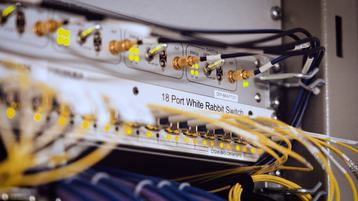

The White Rabbit switch, a key component of the CERN-born open-source timing technology. (Image: CERN)g over commercial optical fiber while a quantum channel is present.
The trial focuses on co-propagation: evaluating how classical timing and quantum signals can share a single fiber without interfering with one another. If successful, the approach would allow quantum links to ride on top of existing telecom infrastructure rather than requiring dedicated dark fiber.
“CERN invented White Rabbit, and quantum networking is now at the core of many technologies that use it,” said Noel Goddard, CEO at Qunnect.
Qunnect’s systems have been used in multiple city-scale research testbeds. CERN’s involvement moves the work toward protocol design and interoperability testing. By hosting multiple vendors and research partners, CERN provides a neutral environment for comparing performance and validating approaches.
“CERN is a metrology opportunity,” Goddard said. “They dive deep into performance and help identify gaps that need to be filled.”
From the lab where the World Wide Web was born, another type of network is beginning to take shape.
Why timing matters in quantum networking
Quantum networking relies on the simultaneous arrival and detection of single photons carrying entangled quantum states. To verify and preserve that entanglement, receivers must be synchronized with extreme precision, often to picosecond-level accuracy.
CERN’s White Rabbit protocol distributes timing over optical fiber using standard Ethernet hardware. Testing White Rabbit alongside entangled-photon links shows whether classical and quantum signals can share a single fiber without interference, an essential step toward scalable quantum networks.
From experiments to infrastructure
The path from today’s demonstrations to a functional quantum internet will take years, possibly decades, but the direction is becoming clearer. Network operators are already experimenting with quantum techniques to relieve optimization bottlenecks and reduce long-term cryptographic risk. As hardware scales and standards mature, the same infrastructure that moves classical bits may also distribute quantum states, keys, and correlations.
That future is emerging quietly: in pilot labs, hybrid network equipment, and secure optical links. It resembles an earlier shift. The World Wide Web began at CERN as a tool for sharing research data. In those same corridors, engineers are now testing how timing signals and entangled photons can coexist on a single fiber. From the birthplace of the web, a different kind of network is beginning to form.
This article first appeared in the SDxCentral Quantum Supplement.
To read more on
- Quantum network security
- Quantum-safe encryption
- Cryptographic sprawl
Comments